This guide is based on published manufacturer specifications, retailer pricing, and widely accepted lighting-design guidelines. We did not install or test every fixture in a controlled environment — product details are verified against official brand pages as of March 2026. Where pricing is listed, it reflects the standard retail price at the time of research and may vary by finish or size.
Why lighting is the most under-planned purchase in home furnishing
Most shoppers obsess over sofas and dining tables, then grab whatever ceiling light is on sale. That is backwards. Lighting shapes how every other piece of furniture looks, how colors read on your walls, and whether a room feels energizing or restful. A $40 pendant can make a $2,000 dining table look intentional. A wrong overhead can make the same table look like it belongs in a break room.
The good news: lighting follows predictable rules. Once you understand fixture types, sizing formulas, and the concept of layered light, choosing the right piece for each room becomes a straightforward process — not a guessing game.
The three layers of light every room needs
Before you browse any product page, understand the framework that professional designers use.
Ambient light is your room's base layer — the general illumination that lets you walk around without bumping into furniture. Flush mounts, semi-flush mounts, recessed cans, and large pendants all serve this role. Aim for 10 to 20 lumens per square foot in living rooms and bedrooms, and 30 to 40 lumens per square foot in kitchens and bathrooms.
Task light targets a specific activity: reading, chopping vegetables, applying makeup. Under-cabinet strips in the kitchen, a desk lamp in the home office, and sconces flanking a bathroom mirror are all task lighting. These fixtures should be bright and focused without casting shadows on your work surface.
Accent light adds depth and drama. Picture lights, LED strip lighting inside shelving, and directional track heads draw attention to art, architectural features, or open shelving. Accent lighting typically runs at roughly three times the lumen level of the ambient light hitting the same surface, creating contrast that makes a room feel layered rather than flat.
The practical rule: every room should have at least two of these layers. Most well-lit rooms have all three. If you are relying on a single overhead fixture and nothing else, that is the first problem to solve.
Fixture types at a glance
| Fixture type | Best for | Ceiling height | Price range |
|---|---|---|---|
| Flush mount | Hallways, closets, bedrooms with low ceilings | Under 8 ft | $13–$300 |
| Semi-flush mount | Bedrooms, kitchens, entryways | 8–9 ft | $50–$400 |
| Pendant | Kitchen islands, dining nooks, bedside | 8 ft+ | $25–$500 |
| Chandelier | Dining rooms, entryways, living rooms | 9 ft+ | $80–$2,000+ |
| Recessed / can light | Kitchens, bathrooms, hallways | Any | $15–$80 per unit |
| Sconce | Bedrooms, hallways, bathrooms | Any | $30–$300 |
| Track / monorail | Living rooms, galleries, open-plan spaces | 8 ft+ | $80–$500 |
How to size a fixture to your room
Getting proportions right prevents the two most common lighting mistakes: a tiny fixture that disappears against the ceiling, or an oversized one that overwhelms the space.
The addition rule for ceiling fixtures
Add the room's length and width in feet. The sum, converted to inches, gives you the approximate fixture diameter. A 12 × 14-foot living room calls for a fixture around 26 inches across. This is a starting point, not a hard rule — but it keeps you in the right range.
Sizing pendants over a kitchen island
The width of each pendant should be one-third to one-half the width of the island. For a 36-inch-wide island, that means pendants between 12 and 18 inches in diameter. Space them 24 to 30 inches apart, and keep the bottom of the shade 30 to 36 inches above the countertop. Use two pendants for islands under 6 feet long, and three for longer islands.
Sizing a chandelier over a dining table
The fixture should span one-half to two-thirds the table's width. Hang it 30 to 36 inches above the table for standard 8-foot ceilings, and raise it 3 inches for every additional foot of ceiling height. If your table seats eight, you can go bigger — an undersized chandelier over a large table looks like an afterthought.
Ceiling height and hanging clearance
The bottom of any hanging fixture should be at least 7 feet from the floor in walkways. In rooms with 8-foot ceilings, that leaves you about 12 inches of drop — which rules out most chandeliers and makes flush or semi-flush mounts the better choice. Pendants and chandeliers really shine in rooms with 9-foot ceilings or higher.
Room-by-room lighting guide
Kitchen
The kitchen demands more light than any other room — 30 to 40 lumens per square foot for general illumination, with dedicated task light over prep zones. A layered kitchen plan typically includes:
- Recessed ceiling lights for ambient coverage (spaced 4 to 6 feet apart)
- Pendant lights over the island for task and visual anchoring
- Under-cabinet LED strips to illuminate countertops without shadows
- In-cabinet lighting if you have glass-front uppers
For the island, the IKEA RANARP pendant lamp is one of the most cost-effective options on the market.
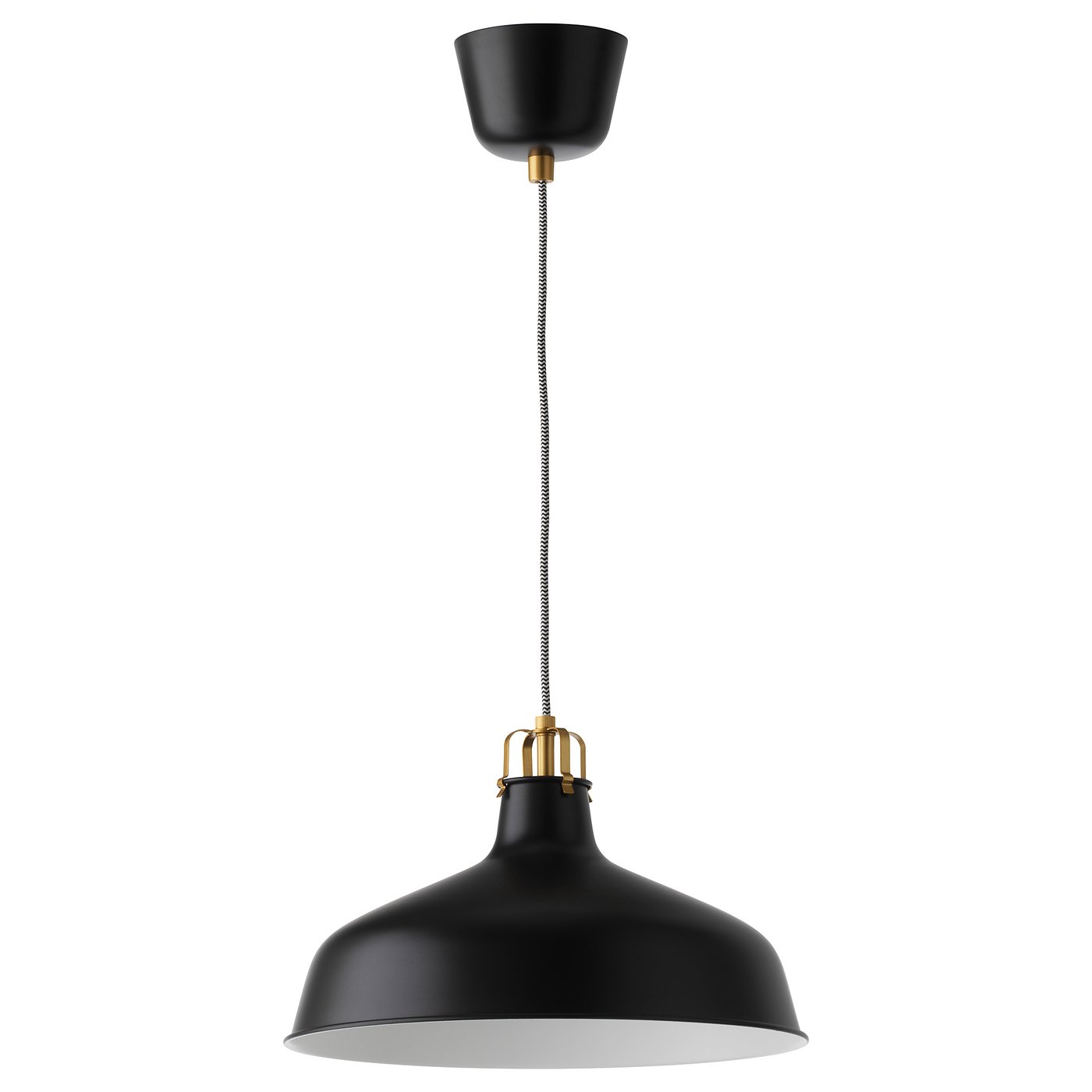
The IKEA RANARP ($49.99, 15-inch diameter) features a powder-coated steel shade with exposed joint connections and a striped textile cord. The industrial profile suits farmhouse, Scandinavian, and transitional kitchens. Its directed downlight makes it genuinely useful over a prep surface, not just decorative.
For a more polished look, the Crate & Barrel Arren Brass Single Pendant ($129, 8-inch clear glass shade) suspends a round glass globe from an iron fixture finished in brass with an adjustable black fabric cord.

The Arren's modular design is a standout: you can group two or three singles over an island, or step up to the Arren Brass 5-Light Linear Pendant ($529) for a single-canopy installation that spans up to 42 inches. The interchangeable shade system — clear, milk, or angled glass in three sizes — lets you adjust the look without replacing the entire fixture. If you are comparing kitchen and dining furniture across Crate & Barrel and West Elm, our Crate & Barrel vs West Elm dining tables comparison covers how their design philosophies differ.
Dining room
The dining room is where a single, well-chosen fixture can define the entire space. This is the one room where a chandelier or statement pendant earns its keep.
The IKEA STOCKHOLM 2025 pendant lamp ($249.99, 21-inch diameter) is IKEA's most design-forward lighting option right now.
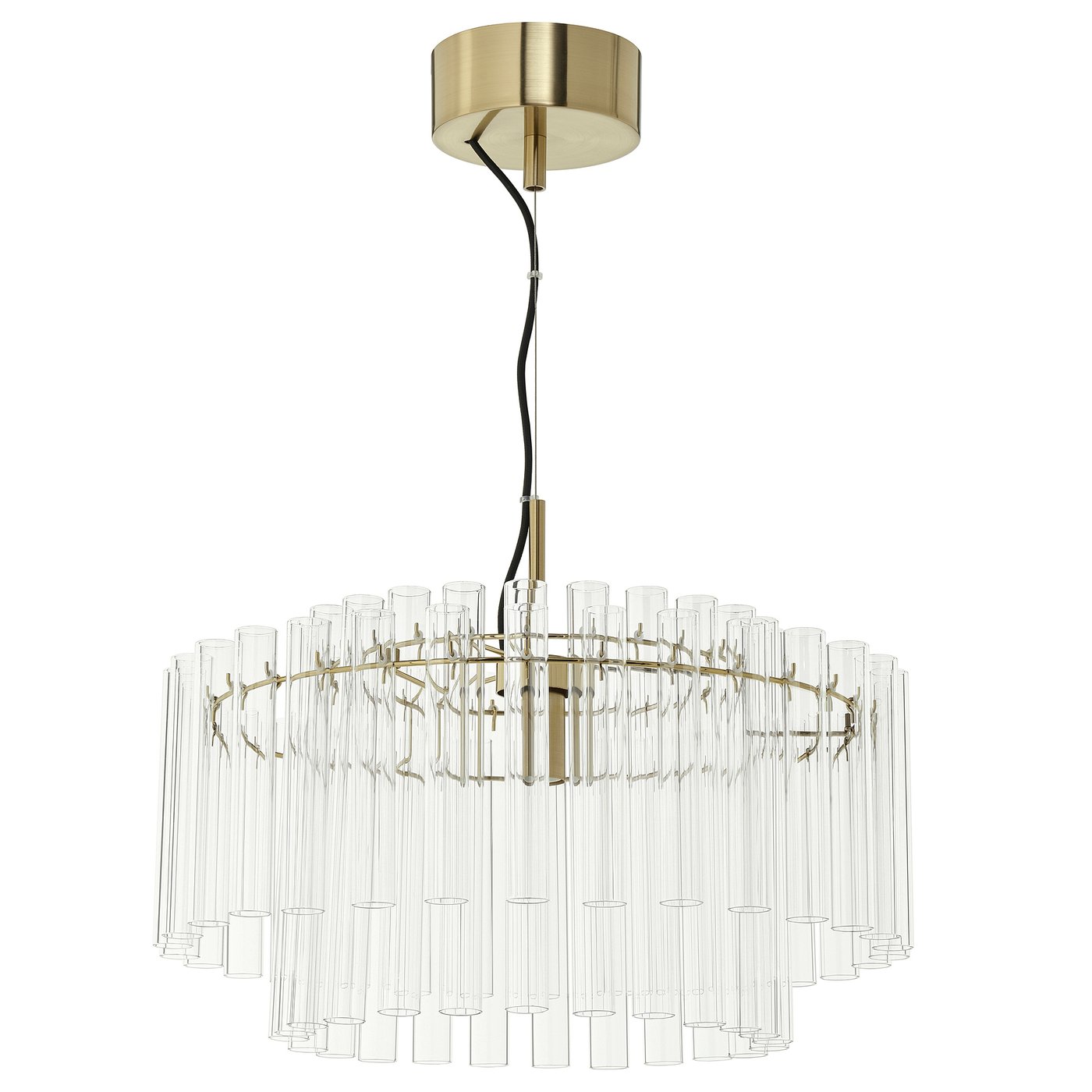
It features hand-blown glass cylinders suspended from a brass-plated ring, creating a chandelier effect without the visual bulk of traditional arms and candelabras. The glass diffuses light softly — warm enough for dinner, bright enough to read a menu. At $249, it competes with fixtures three times its price from specialty lighting brands.
For larger dining tables, the West Elm Mobile Chandelier (from $299, available in 29-inch and 55-inch spans) is a mid-century modern icon. Its adjustable arms in antique brass or bronze hold six E26 sockets, and the open, airy silhouette works over both round and rectangular tables without blocking sightlines. The 55-inch version suits tables seating six to eight. West Elm's lighting pairs naturally with their furniture lines — if you are also furnishing a living room, our IKEA vs Wayfair sofas comparison breaks down value across retailers.
Sizing reminder: for a 72-inch dining table, your fixture should be 36 to 48 inches wide. Hang it 30 to 36 inches above the tabletop, and center it over the table, not the room.
Living room
Living rooms need the most layered approach because they serve the most functions: watching TV, reading, hosting, relaxing. Plan for at least three to five light sources.
Ambient layer: A semi-flush mount or large flush mount anchors the ceiling. A floor lamp in the corner fills in shadows the ceiling fixture misses.
Task layer: A table lamp on an end table or console provides reading light. An adjustable floor lamp (like an arc lamp) can serve double duty.
Accent layer: LED strip lighting behind a media console, picture lights over art, or a small accent lamp on a bookshelf adds depth.
The IKEA SINNERLIG pendant lamp ($99.99, 20-inch diameter) is a natural-material option that works beautifully as a living room statement piece.
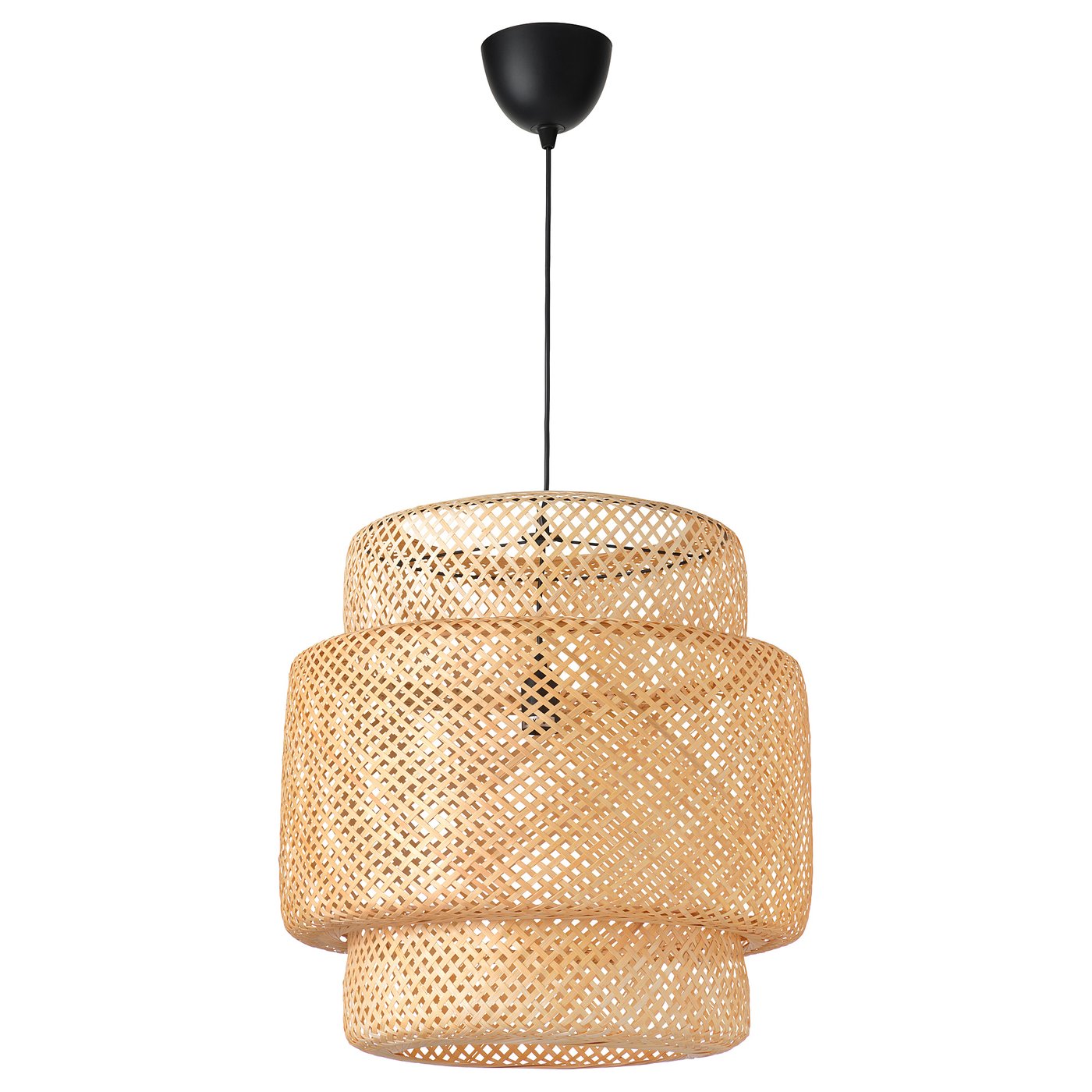
Designed by Ilse Crawford, the SINNERLIG is handwoven from bamboo — each piece is unique. It casts warm, patterned light through the lattice weave, creating the kind of visual texture that makes a room feel lived-in rather than staged. At $99.99, it is one of the best value-to-design-impact fixtures available anywhere. It works best in rooms with 9-foot or higher ceilings where the 21-inch shade height has room to breathe.
For a more structured modern look, Wayfair's sputnik-style chandeliers start around $78 (such as the Orren Ellis Lorise 10-Light Sputnik, regularly $106, frequently discounted to $78). These mid-century-inspired fixtures work well in living rooms with 8- to 9-foot ceilings and provide broad, even ambient light from multiple bulb positions.
Bedroom
Bedrooms should feel calm, which means lower lumens (10 to 20 per square foot) and warm color temperatures (2700K). The biggest bedroom lighting mistake is installing a single, bright overhead and calling it done. Instead, aim for:
- A flush or semi-flush mount for ambient light (put it on a dimmer)
- Bedside sconces or table lamps for reading (freeing up nightstand space with wall-mounted sconces is a popular upgrade)
- An optional accent source like LED strips behind a headboard
The IKEA HEKTAR pendant lamp ($39.99, 9-inch diameter) works surprisingly well as a bedroom pendant when ceiling height allows.
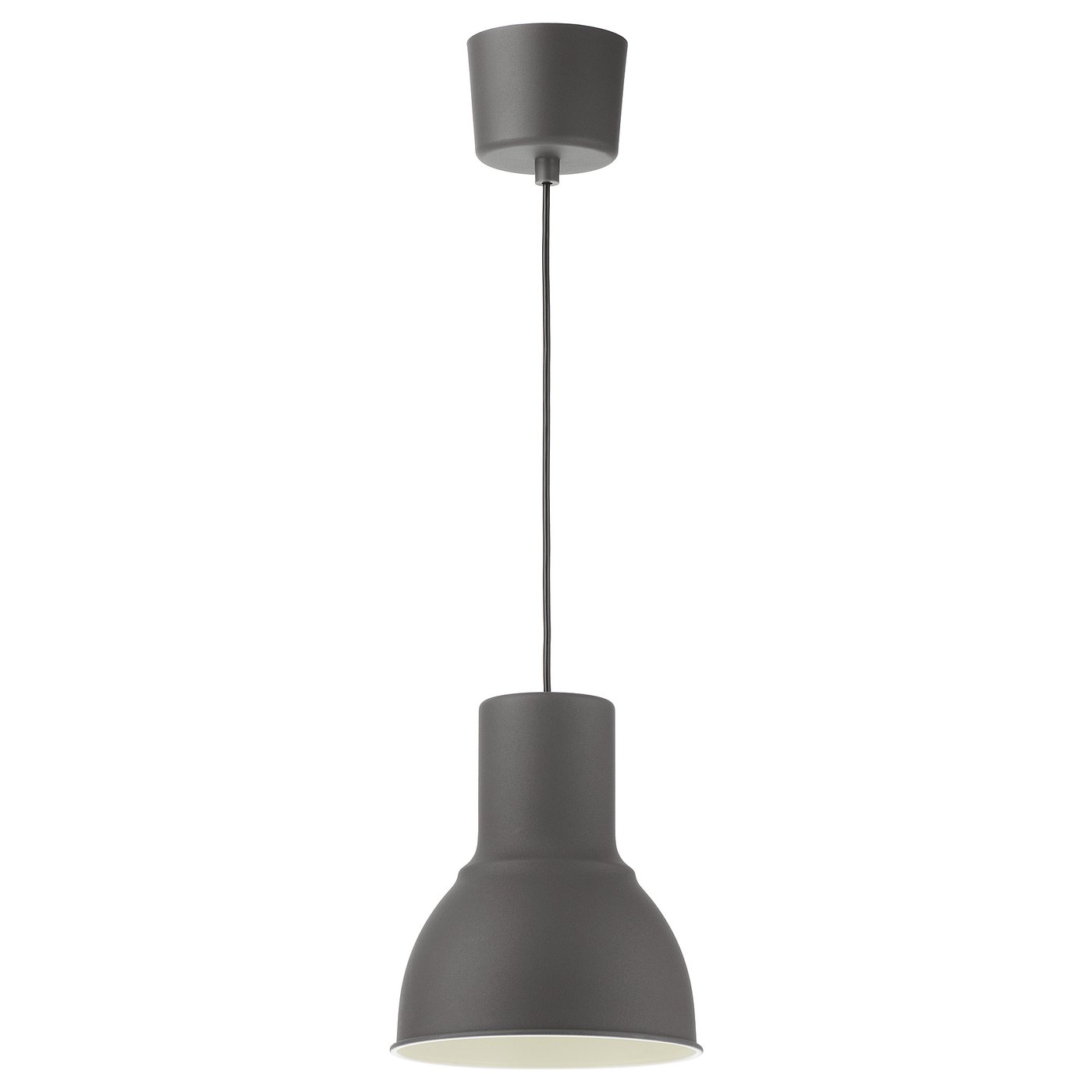
The HEKTAR's industrial silhouette — a simple oversized metal dome in dark gray powder-coated steel — reads as intentional and designer-influenced, not budget. The 9-inch version keeps the scale appropriate for bedrooms, while the 15-inch ($49.99) and 19-inch ($99.99) models suit larger spaces. All three feature an interior reflector that directs light downward while the shade blocks glare from bed level — exactly the kind of directed illumination that makes a bedroom feel cozy rather than clinical.
Flush-mount options for low-ceiling bedrooms include the West Elm Mitchel Flushmount (from $129) in matte black or polished nickel, and the West Elm Edie Prismatic Flushmount ($159), which uses a faceted glass shade to scatter light in patterns across the ceiling.
Bathroom
Bathroom lighting is functional first. You need bright, even light at the mirror for grooming, and moisture-rated fixtures rated for damp or wet locations.
- Vanity sconces flanking the mirror at eye level (roughly 60 to 65 inches from the floor) eliminate the under-eye shadows that a single overhead creates
- A flush mount provides ambient light for the rest of the space
- Shower-rated recessed lights (wet-rated, IC-rated) are necessary inside enclosed showers
Color temperature matters here: 3000K to 3500K is the sweet spot. It's bright enough to see clearly but warm enough to avoid the harsh, clinical feel of cool-white bulbs.
Entryway and hallway
These transitional spaces need simple, reliable ambient light. Flush mounts are the default for hallways with standard 8-foot ceilings. For two-story entryways or foyers with high ceilings, a pendant or chandelier creates a strong first impression.
Sizing a foyer fixture: measure the foyer's width and depth in feet, add them together, and convert to inches. A 6 × 8-foot entryway calls for a fixture around 14 inches across. If the ceiling is 10+ feet, a pendant on a longer drop adds vertical drama.
Home office
Offices need 30 to 50 lumens per square foot — brighter than a living room, dimmer than a kitchen. The key is eliminating screen glare and reducing eye strain:
- Position the desk so ceiling lights are not directly above the monitor
- Use a bias light (LED strip behind the monitor) to reduce contrast between the screen and the wall
- Add a task lamp with adjustable color temperature — cooler (4000K) for focus work, warmer (3000K) for video calls
Choosing the right color temperature
Color temperature is measured in Kelvin (K) and changes the mood of a room as much as the fixture itself.
| Kelvin range | Description | Best for |
|---|---|---|
| 2200–2700K | Warm / candlelight | Bedrooms, dining rooms, living rooms |
| 3000K | Warm white | Kitchens, bathrooms, general purpose |
| 3500K | Neutral white | Kitchens, home offices |
| 4000–5000K | Cool / daylight | Garages, workshops, task areas |
The 2026 trend: tunable LED fixtures that let you shift color temperature throughout the day — cooler light in the morning, warmer in the evening — are becoming mainstream. IKEA's smart lighting system (DIRIGERA hub with TRÅDFRI bulbs) offers this functionality starting around $30 for a two-bulb kit plus hub.
How to plan lighting for an entire home without it looking random
The biggest difference between a professionally designed home and a DIY one is visual continuity in the lighting. Here is how to achieve it:
Pick a dominant metal finish for the entire home — brass, matte black, and brushed nickel are the three safest choices. Use this finish on your most visible fixtures (kitchen pendants, dining chandelier, entry sconce).
Allow one secondary finish. If your dominant finish is brass, your secondary might be matte black. This appears in smaller fixtures — bathroom sconces, closet flush mounts, desk lamps.
Keep fixture families consistent in connected sight lines. If you can see the kitchen from the dining room, those fixtures should feel related — not identical, but from the same design universe. The Crate & Barrel Arren collection does this well: a single pendant over the sink, a 3-light cluster over the island, and a 5-light linear over the dining table all share the same frame and shade language.
Vary fixture types, not styles. A matte-black flush mount in the hallway, a matte-black pendant in the kitchen, and a matte-black sconce in the bedroom create cohesion through finish even though the fixtures are different shapes.
If you are planning a broader home furnishing project, timing your lighting purchases around sales cycles can save 20 to 40 percent. Our home improvement seasonal sales guide covers when each major retailer runs its best lighting promotions.
Budget framework: what to expect at each price tier
Under $50: IKEA
IKEA dominates the entry-level space with fixtures that look far more expensive than they cost. The HEKTAR ($39.99), RANARP ($49.99), and MELODI ($12.99) lines cover industrial, vintage, and minimal styles respectively. Build quality is decent — powder-coated steel, real glass where used — but cords are short and installation hardware is basic. For a full profile of their product range, see our IKEA brand profile.
$50–$200: IKEA premium and Wayfair
IKEA's upper range includes the SINNERLIG ($99.99) and the stunning STOCKHOLM 2025 ($249.99). Wayfair fills this tier with enormous selection — over 20,000 ceiling fixtures — at aggressive price points. The tradeoff is inconsistency: some Wayfair brands deliver excellent quality, others cut corners on wiring and finish durability. Read reviews carefully and check return policies. Our Wayfair brand profile has more detail on navigating their marketplace model.
$200–$600: Crate & Barrel, West Elm, Rejuvenation
This is the sweet spot for design-forward fixtures with solid build quality. The Crate & Barrel Arren collection ($129–$529) and the West Elm Sculptural Glass collection (from approximately $149) both offer the kind of material quality and design detail that makes a room look finished. West Elm's Mobile Chandelier (from $299) remains one of the best mid-century dining fixtures at its price. Finishes like antique brass and polished nickel are applied with more care than budget alternatives, and glass shades use thicker, better-quality glass.
$600+: Visual Comfort, Schoolhouse, Circa Lighting
At this tier, you are paying for designer names, commercial-grade construction, and finishes that age well over decades. Worth it for a statement dining chandelier or an entryway fixture you will look at every day. Not necessary for hallway flush mounts or closet lights.
Installation considerations
Hardwired vs. plug-in
Most ceiling fixtures are hardwired, meaning they connect directly to your home's electrical wiring and are controlled by a wall switch. This requires either an existing junction box in the ceiling or an electrician to install one. Plug-in pendants — which include a cord that runs to a wall outlet — are a renter-friendly alternative. West Elm's Sculptural Glass collection and several IKEA pendants offer plug-in versions.
Dimmer compatibility
Not all LED fixtures work with standard dimmers. If you plan to use dimmers (and you should — they instantly increase a fixture's versatility), check that both the fixture and the bulb are rated as dimmable and compatible with your dimmer type (leading-edge or trailing-edge). IKEA and West Elm both list dimmer compatibility on their product pages.
Weight and mounting
Heavier fixtures — anything over 15 pounds — require a ceiling fan-rated junction box that is anchored to a joist, not just drywall. The West Elm Mobile Chandelier and multi-light Arren pendants both fall in this weight range. If your existing box is a lightweight pancake style, budget $100–$200 for an electrician to swap it out before installation.
A practical lighting plan for a two-bedroom apartment
To show how these principles come together, here is a sample plan using only fixtures discussed in this guide:
| Room | Fixture | Product | Est. cost |
|---|---|---|---|
| Kitchen (ambient) | Recessed LED (×4) | Any IC-rated 6" can | $120 |
| Kitchen (island) | Pendant (×2) | IKEA RANARP | $100 |
| Kitchen (task) | LED strip | Under-cabinet kit | $40 |
| Dining | Pendant | IKEA STOCKHOLM 2025 | $250 |
| Living room (ambient) | Semi-flush mount | West Elm Mitchel | $129 |
| Living room (accent) | Floor lamp | Any arc lamp | $100 |
| Bedroom (ambient) | Flush mount | IKEA HEKTAR 9" | $40 |
| Bedroom (task) | Table lamp (×2) | Any ceramic base | $80 |
| Bathroom | Vanity sconce (×2) | Any damp-rated pair | $120 |
| Hallway | Flush mount | IKEA basic | $20 |
| Total | ~$999 |
That is a fully layered, cohesive lighting plan for under $1,000 — and it will look intentional, not thrown together. Swap in the Crate & Barrel Arren or West Elm options and the budget climbs to $1,500–$2,000, with a proportional jump in materials and finish quality.
If you are also outfitting outdoor spaces, our outdoor furniture buying guide covers material durability for items that face weather exposure — many of the same principles around material quality apply to outdoor lighting fixtures.
Final checklist before you buy
- Measured the room and calculated the recommended fixture diameter
- Checked ceiling height and confirmed adequate hanging clearance (7-foot minimum from floor)
- Identified at least two lighting layers for each room
- Verified lumen output meets the room's needs (multiply square footage by lumens-per-square-foot target)
- Confirmed dimmer compatibility if you plan to install dimmers
- Checked junction box rating for heavier fixtures (over 15 lbs)
- Selected no more than two or three metal finishes for connected spaces
- Compared prices across the seasonal sale calendar — lighting promotions peak during Presidents' Day, Memorial Day, and Black Friday
Good lighting is not about finding the one perfect fixture. It is about building a plan where every source has a job, every fixture is proportioned to its space, and the finishes feel like they belong in the same home. Start with the three-layer rule, size to the room, and buy the best quality your budget allows.