Spring is when air purifier sales spike — pollen counts climb, windows open, and suddenly every breath feels like a gamble. If you have been comparing options, you have probably landed on two names that keep surfacing: Dyson and Coway.
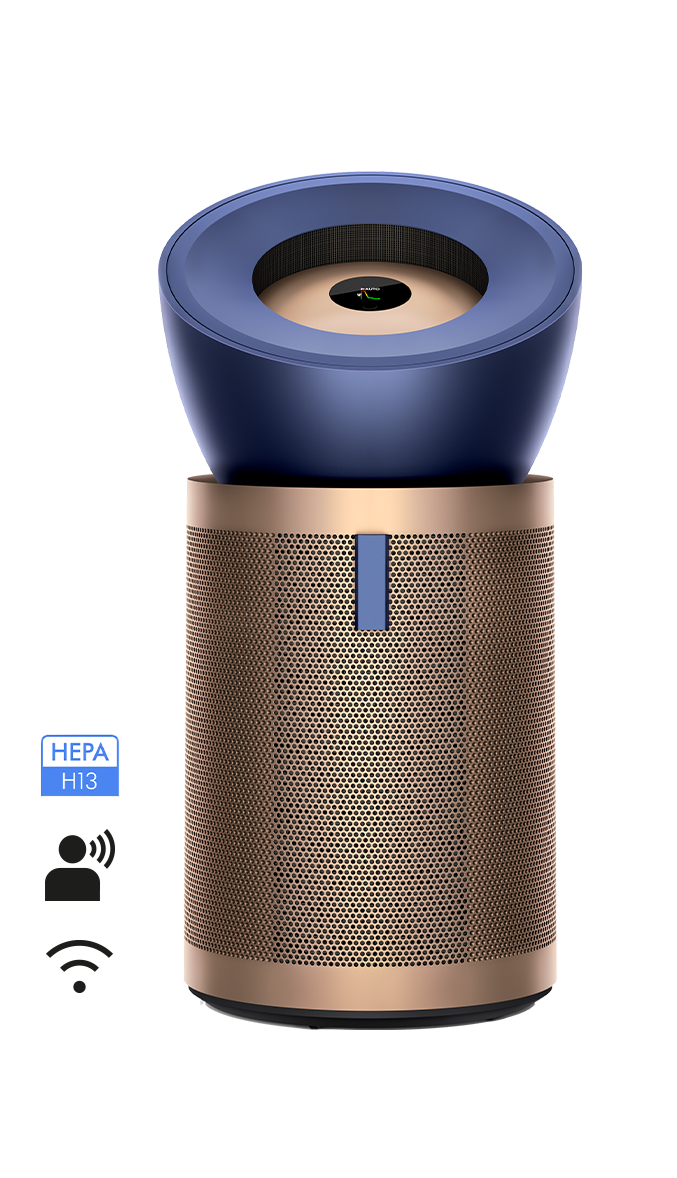
The Dyson Big+Quiet Formaldehyde BP04 sits at $999 (or $1,099 in the gold finish). The Coway Airmega 250S asks $449. That is a $550 gap for machines that both promise to clean the air in a large room. The question worth answering: what exactly does the Dyson's premium buy you, and is any of it worth paying for?
How we compared them
This comparison draws on published CADR data (where available), manufacturer specifications, and editorial reviews from HouseFresh, TechHive, Reviewed, and TechRadar. Neither unit was tested firsthand — all performance claims are sourced and linked. Where data is unavailable (notably Dyson's CADR), we note the gap rather than guess.
Filtration performance: published numbers vs proprietary testing
The Coway Airmega 250S posts clear CADR ratings: 249 for smoke, 261 for dust, and 230 for pollen. These numbers are independently verified through the AHAM (Association of Home Appliance Manufacturers) standard, and they place the Coway solidly in the upper tier for its price range.
Dyson does not publish CADR ratings. The company argues that standard CADR testing — conducted in a small sealed chamber — fails to represent how air moves in real living spaces. Instead, Dyson tests in a 100-square-meter room with 36 distributed sensors. The result: Dyson claims thorough, even purification across the entire room, but buyers cannot directly compare that claim against competitors on a standardized scale.
Both units use HEPA filtration. The Dyson BP04 uses an H13-grade HEPA filter rated to capture 99.97 percent of particles down to 0.3 microns. The Coway uses a Green True HEPA filter with the same 99.97 percent capture rate at 0.3 microns, paired with activated carbon for odors and VOCs.
The Dyson's standout feature is its Selective Catalytic Oxidisation (SCO) filter, which breaks formaldehyde molecules into water and CO2. This is not just carbon adsorption that saturates over time — it is a catalytic process that regenerates. If your home has active formaldehyde off-gassing from new flooring, cabinetry, or paint, this is a capability the Coway simply does not offer.
For general particulate filtration — pollen, dust, pet dander, smoke — the Coway gives you verifiable, standardized data. The Dyson asks you to trust its proprietary testing methodology.
Room coverage and airflow
| Specification | Dyson BP04 | Coway Airmega 250S |
|---|---|---|
| Room coverage | Up to 1,076 sq ft | Up to 930 sq ft |
| Air projection | Up to 33 feet | Not specified |
| CADR (smoke) | Not published | 249 |
| CADR (dust) | Not published | 261 |
| CADR (pollen) | Not published | 230 |
The Dyson covers roughly 15 percent more floor area — a meaningful difference if you have an open-plan living space over 930 square feet. For rooms under that threshold, both machines are adequately sized, and the Coway's published CADR numbers let you calculate air changes per hour with confidence.
Noise levels
The Coway Airmega 250S runs from 22 dB on its lowest setting to 54 dB at maximum. At 22 dB, it is quieter than a whisper — genuinely inaudible from across a room.
Dyson markets the BP04 as its "quietest purifier ever" and highlights its Helmholtz silencer and labyrinth seal acoustic engineering. However, Dyson does not publish specific dB readings for each fan speed. Editorial reviewers from Expert Reviews and TechRadar confirm it runs quietly, particularly on lower settings, but the lack of standardized noise data makes precise comparison impossible.
If verified noise performance matters to your purchase decision, the Coway gives you actual numbers to evaluate.
Sensors and smart features
This is where the Dyson pulls ahead decisively.
Dyson BP04 sensors monitor: PM2.5, PM10, VOCs, NO2, formaldehyde, CO2, temperature, and humidity. The MyDyson app displays real-time readings for each pollutant, letting you track air quality trends over time.
Coway Airmega 250S sensors monitor: overall air quality via a color-coded LED ring. The Coway IoCare app provides remote control and basic air quality status, and the unit works with Google Assistant and Amazon Alexa for voice commands.
The difference is substantial. The Dyson tells you what is in your air — down to individual pollutant concentrations. The Coway tells you whether air quality is good, moderate, or poor, with no granular breakdown.
If you want to understand whether your indoor CO2 is creeping up during a meeting, or whether your new desk is off-gassing formaldehyde, only the Dyson provides that data.
Filter replacement and five-year cost
Long-term cost is where the Coway's value proposition becomes hard to argue against.
| Cost category | Dyson BP04 | Coway Airmega 250S |
|---|---|---|
| Purchase price | $999 | $449 |
| Filter replacement interval | ~5 years (HEPA + carbon) | ~1 year (Max2 filter) |
| Filter replacement cost | ~$80–100 (estimated) | $79 per year |
| SCO filter replacement | Never (catalytic, regenerates) | N/A |
| Estimated 5-year total | ~$1,079–1,099 | ~$844 |
Even accounting for the Coway's annual filter swaps, the five-year ownership cost is roughly $235 less than the Dyson. The Dyson's longer filter lifespan partially offsets its higher purchase price, but it does not close the gap entirely.
The Coway is also Energy Star certified with a 64W power draw. The Dyson does not publish energy consumption figures, though its larger motor and sensor array likely draw more power.
Design and build
The Dyson BP04 is a tall, cylindrical tower at 26.2 pounds. It projects purified air through a bladeless amplifier loop, doubling as a subtle room fan. The design is unmistakably Dyson — polarizing, but undeniably engineered.
The Coway Airmega 250S is a compact rectangular unit at 20.5 pounds (18.5 x 19.7 x 8.3 inches). Its square mesh fascia and brushed metal accents look more like a decorative panel than an appliance. Gear Patrol called it "the A5 Wagyu beef of air purifiers" for its build quality relative to its price.
Both are well-made. The Dyson commands more visual attention; the Coway blends in.
Who should buy the Dyson Big+Quiet Formaldehyde BP04
The Dyson earns its price in specific scenarios:
- New construction or renovation: Active formaldehyde off-gassing from engineered wood, fresh paint, insulation, or new furniture. The SCO catalytic filter is a genuine differentiator here.
- Large open spaces over 930 square feet: The Dyson's 1,076-square-foot coverage and 33-foot air projection handle big rooms better.
- Air quality data enthusiasts: If you want granular, real-time pollutant breakdowns — PM2.5, NO2, CO2, formaldehyde levels — the Dyson's sensor suite is unmatched at this price point.
Who should buy the Coway Airmega 250S
The Coway is the stronger choice for the majority of households:
- General allergen and dust control: Published CADR numbers confirm it handles pollen, dust, and pet dander effectively in rooms up to 930 square feet.
- Budget-conscious buyers: $550 less upfront, and lower five-year ownership costs.
- Noise-sensitive environments: A verified 22 dB minimum is exceptionally quiet.
- Straightforward operation: Set it to auto mode and let it run. The air quality LED and app give you enough feedback without overwhelming you with data.
The verdict
The Dyson Big+Quiet Formaldehyde BP04 is a genuinely impressive machine with capabilities the Coway cannot match — formaldehyde destruction, multi-pollutant sensor monitoring, and larger room coverage. But those capabilities serve a narrow set of use cases.
For most people buying an air purifier in 2026 — dealing with seasonal allergies, pet dander, or general dust — the Coway Airmega 250S delivers proven filtration performance at less than half the price. Its CADR numbers are published and verifiable. Its noise floor is documented. Its filter costs are predictable.
Pay the Dyson premium if you have a specific reason to. Otherwise, the Coway earns the recommendation.
Prices referenced in this article were verified as of March 2026. Dyson BP04 at $999.99 via dyson.com. Coway Airmega 250S at $449 via cowaymega.com.
Related reading
If you are upgrading multiple areas of your home, our Roomba Combo 10 Max vs Roborock Saros 10R comparison covers the same value-vs-premium question for robot vacuums. For kitchen upgrades, check our best kitchen organizers roundup. And if you are planning a broader home refresh, our guide to choosing lighting fixtures and seasonal home improvement sales calendar can help you time your purchases.