Cosori vs Ninja Air Fryer: Which One Fits Your Kitchen?
Choosing between Cosori and Ninja looks simple until you compare the actual models. Both brands make well-known air fryers, both show up in kitchen roundups, and both promise crisp food with less oil than deep frying. The practical difference is not brand reputation. It is basket size, control style, and how often you cook full meals instead of snacks.
This comparison focuses on the Cosori Dual Blaze 6.8-Quart Smart Air Fryer and the Ninja AF101 4-Quart Air Fryer. The short version: Cosori fits larger households and people who want smart controls; Ninja fits smaller kitchens and buyers who want a compact machine that does the basics without an app. We base this guide on manufacturer specifications, published editorial testing, and current product documentation, not firsthand lab testing. See our editorial policy and about page for how we evaluate home appliances.
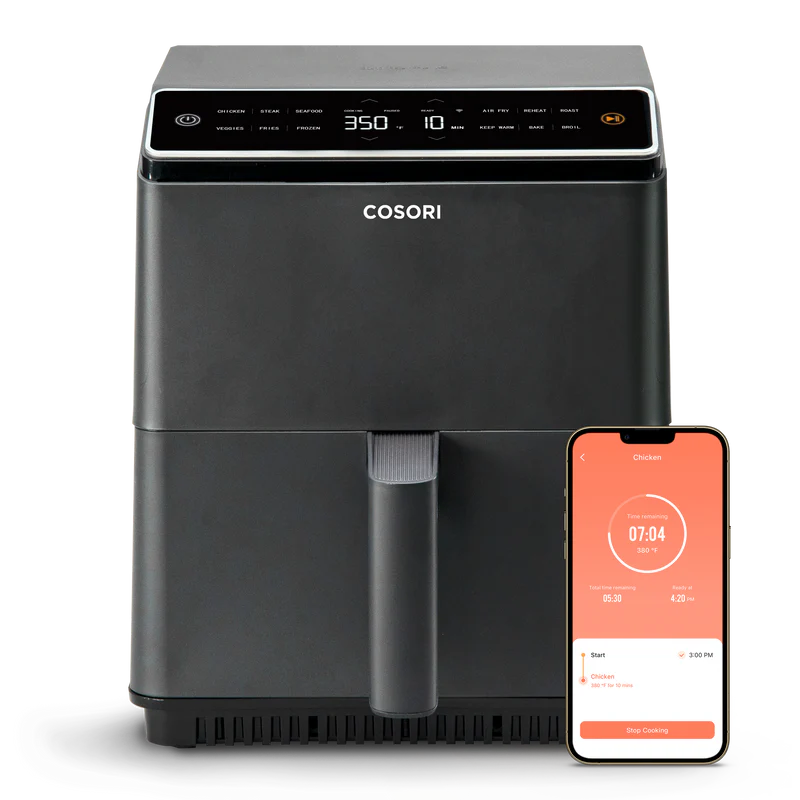
Cosori vs Ninja Air Fryer: quick verdict
The Cosori Dual Blaze is the more capable pick if you cook for three or more people. Its 6.8-quart basket gives you more usable surface area, and Cosori's upper-and-lower heating design is meant to reduce shaking and flipping. The VeSync app and voice assistant support are useful if you like guided recipes or remote monitoring.
The Ninja AF101 is the more sensible pick if you cook for one or two people. Its 4-quart basket fits up to 2 pounds of fries, according to Ninja support, and its compact footprint is easier to live with in an apartment kitchen. It skips smart features, but that is part of the appeal: fewer settings, fewer decisions, fewer things to ignore.
If prices are close, buy based on household size first. A small basket creates batch cooking; an oversized air fryer takes up counter space every day.
Specs at a glance
| Feature | Cosori Dual Blaze 6.8-Quart | Ninja AF101 4-Quart |
|---|---|---|
| Capacity | 6.8 qt / 6.4 L | 4 qt |
| Power | 1750W | 1550W |
| Temperature range | 175-400°F | 105-400°F |
| Cooking functions | 12 listed functions | Air Fry, Roast, Reheat, Dehydrate |
| Smart controls | VeSync app, Alexa, Google Assistant | No app controls |
| Basket style | Large square basket | Compact ceramic-coated basket |
| Best fit | Families, batch cooking, smart homes | Singles, couples, small kitchens |
| Current source | Cosori product page | Ninja AF100 series support |
Cosori Dual Blaze 6.8-Quart: bigger basket, smarter controls
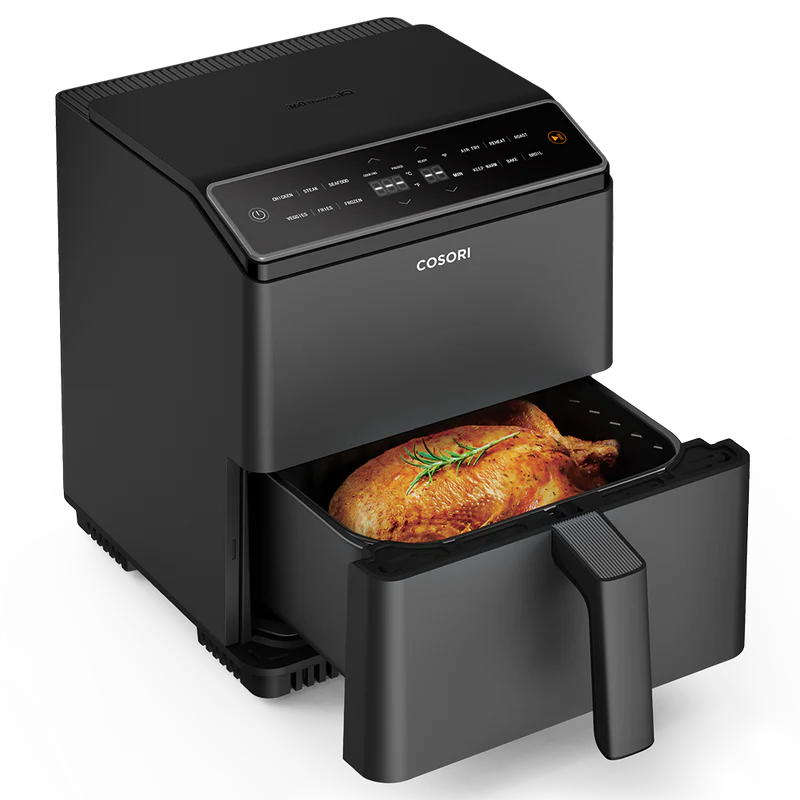
Cosori's Dual Blaze is built around capacity and convenience. The official spec sheet lists a 6.8-quart basket, 1750W power draw, and a 175-400°F temperature range. Cosori also lists 12 cooking functions, including air fry, roast, bake, broil, reheat, fries, frozen, chicken, steak, seafood, veggies, and keep warm.
The important feature is not the number of presets. It is the dual heating element design. Cosori says the fryer uses top and bottom heating to cook both sides more evenly with less shaking or flipping. That matters when you fill the basket with fries, vegetables, or chicken pieces, because a crowded single-element fryer can brown the top before the bottom catches up.
Smart controls are the other differentiator. The Dual Blaze connects through the VeSync app and supports Amazon Alexa and Google Assistant. You can monitor progress, use guided recipes, and control some settings remotely. If you already ignore smart appliance apps, this will not change how dinner gets made. If you like recipe prompts and reminders, it removes friction.
The trade-off is size. A 6.8-quart fryer is not a small appliance. It earns its counter space if you cook full meals or larger batches. It is harder to justify if you mostly reheat leftovers or make snacks for one person.
Ninja AF101 4-Quart: compact, simple, and focused
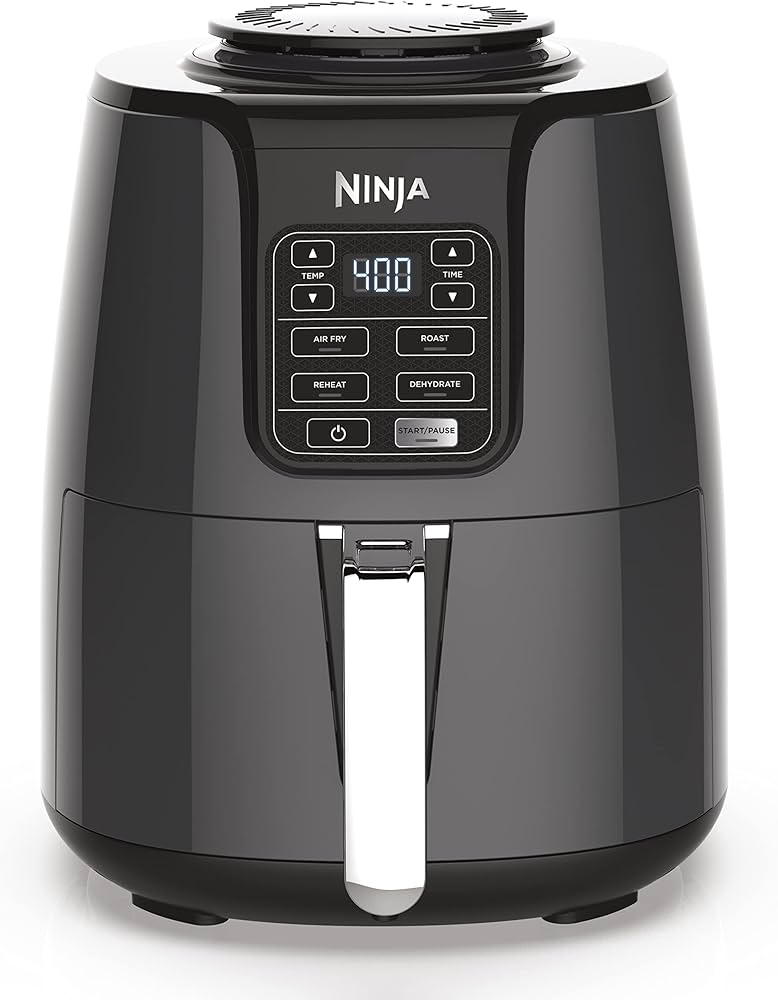
The Ninja AF101 is a smaller, older, simpler air fryer — and that is not automatically a weakness. Ninja support lists a 4-quart basket, 1550W power, and dimensions of about 14 x 11 x 13 inches. It can hold up to 2 pounds of fries, which is enough for one or two people and workable for a small side dish.
The AF101 gives you four core modes: Air Fry, Roast, Reheat, and Dehydrate. Its temperature range is wider at the low end than the Cosori, running from 105-400°F. That lower temperature floor matters if you use the dehydrating function for fruit, herbs, or snacks.
The ceramic-coated basket is the practical everyday advantage. It is designed for easy food release and cleaning, and it avoids the large sink footprint of the Cosori basket. For small apartments, dorm-style kitchens, or anyone who stores appliances between uses, the Ninja is less disruptive.
Independent testing from BestReviews found both Cosori and Ninja broadly capable, while noting Cosori's strength in capacity and smart features and Ninja's strength in compact basket-style designs. That lines up with the model-level decision here: Cosori gives you more room and more controls; Ninja gives you enough fryer for smaller households without much complexity.
Where each one wins
Capacity: Cosori wins. The 6.8-quart basket gives you more room for chicken thighs, vegetables, or fries in a single layer. For households of three or more, this reduces the need to run two batches.
Counter space: Ninja wins. The AF101 is easier to place under cabinets, move around, or store after cooking. If counter space is already crowded, this matters more than smart features.
Controls: Cosori wins for guided cooking; Ninja wins for simplicity. The VeSync app can help new users with recipes and monitoring. The Ninja's simpler interface is better for people who do not want another connected appliance.
Temperature range: Ninja wins at the low end; both top out at 400°F. The AF101 can go down to 105°F, which supports dehydration. Cosori starts at 175°F but adds more preset cooking programs.
Batch cooking: Cosori wins. More basket area means fewer crowded batches, which helps texture. The Ninja works well when you cook smaller portions and keep the basket from overfilling.
How to decide by household size and cooking style
For a one-person kitchen, basket size is often less important than appliance friction. If the fryer is light enough to move, quick to rinse, and simple to start, it will get used more often. That points toward the Ninja AF101. It can handle frozen snacks, reheated leftovers, small vegetable sides, and one or two portions of chicken without turning cooking into a setup process.
For a three- or four-person household, the limitation changes. You are no longer asking whether the fryer can cook food; you are asking whether it can cook enough food at once. A crowded 4-quart basket makes fries steam instead of crisp and forces proteins into overlapping layers. That is where the Cosori Dual Blaze becomes more practical. The larger basket gives food more room, and the dual heating element design is more useful when the basket is fuller.
For mixed-use kitchens, think about who will operate the appliance. If several family members will use it, presets and app guidance may reduce mistakes. If only one person cooks and already knows preferred times and temperatures, the simpler Ninja interface may be faster.
Price and long-term value
Prices move often, so treat any dollar figure as a snapshot rather than a permanent fact. Cosori's official Dual Blaze listing has recently shown both regular pricing and limited-time pricing, while Ninja AF101 pricing varies heavily by retailer and sale period.
The value decision is still straightforward. If both are within roughly $20-40 of each other, capacity should drive the decision. A larger Cosori that prevents second batches is worth paying for if you cook family meals. A smaller Ninja that you actually leave on the counter is better value if you cook small portions.
Cleaning also affects long-term value. A fryer that is annoying to clean gets used less. The Cosori basket gives more room but takes more space in the sink or dishwasher. The Ninja basket is smaller and easier to handle, though you give up cooking area.
Which one should you buy?
Choose the Cosori Dual Blaze if you cook for three or more people, want a larger basket, and like the idea of app-guided cooking. It is the more flexible household fryer and the better match for batch cooking.
Choose the Ninja AF101 if you cook for one or two people, have limited counter space, or want an air fryer that does not depend on smart features. It is easier to store, easier to clean, and focused on the core job.
If you are building a broader kitchen setup, the same size-versus-flexibility trade-off appears in our Ninja Foodi vs Instant Pot comparison and Ninja vs Keurig coffee maker guide. For coffee decisions, also see Keurig vs Nespresso and Breville Barista Express vs De'Longhi La Specialista Arte.
Frequently asked questions
Is Cosori better than Ninja for air frying?
Cosori is better if you want more capacity, smart controls, and a larger square basket for family cooking. Ninja is better if you want a smaller machine with simple controls and a ceramic-coated basket. The right choice depends more on household size than on brand name.
Is the Ninja AF101 big enough for a family?
Usually no. The 4-quart basket can fit up to 2 pounds of fries, but a family meal often needs more surface area than that. For three or more people, the Cosori Dual Blaze's 6.8-quart basket is more practical because it reduces batch cooking.
Does the Cosori Dual Blaze need shaking?
Cosori says the Dual Blaze uses upper and lower heating elements to cook both sides more evenly with less shaking or flipping. That does not mean shaking is useless. If the basket is crowded with fries or vegetables, a mid-cook shake can still improve texture.
Which air fryer is easier to clean?
The Ninja AF101 is easier to handle because its basket is smaller. The Cosori basket is larger, which helps cooking capacity but takes more sink or dishwasher space. Both use removable baskets and crisper plates, so neither is difficult if cleaned soon after cooking.
Which one is better for small apartments?
The Ninja AF101 is the better starting point for small apartments. It takes up less counter space and handles small portions well. Choose the Cosori only if the extra capacity will be used often enough to justify the larger footprint.
Bottom line
The Cosori Dual Blaze and Ninja AF101 are not trying to solve the same kitchen problem. Cosori is for larger batches, smart controls, and fewer compromises when cooking for multiple people. Ninja is for compact kitchens, smaller portions, and a simpler daily routine.
Match the machine to your actual cooking pattern. That matters more than choosing the brand that sounds stronger in a general air fryer debate.
Title Candidates
- Cosori vs Ninja Air Fryer: Which One Fits Your Kitchen? — direct intent match
- Cosori Dual Blaze vs Ninja AF101: Capacity, Controls, and Price Compared — concrete feature comparison
- Cosori or Ninja? The Air Fryer Choice Comes Down to Household Size — counterintuitive angle
- Ninja AF101 vs Cosori Dual Blaze: Small Kitchen or Family Batch Cooking? — audience segmentation
- Cosori vs Ninja Air Fryer: The Practical Buying Guide for 2026 — current-year search framing
Sources: Cosori Dual Blaze official product page, Ninja AF100 Series support FAQ, BestReviews Cosori vs Ninja air fryer comparison. Prices and availability can change; verify current retailer listings before purchasing.