Breville Espresso Machines Review: Bambino Plus, Barista Express, and Touch Impress Compared
Buying a Breville espresso machine is not just a choice between three stainless-steel appliances. It is a choice between three morning routines. One asks you to bring your own grinder. One teaches you dose, grind, tamp, and milk by doing. One tries to guide the hard parts so you can get to the drink faster.
The right Breville model is the one whose workflow you will actually repeat before work, not the one with the longest feature list. This Breville espresso machines review compares the Bambino Plus, Barista Express, and Barista Touch Impress using Breville's official US product pages checked on May 25, 2026, plus independent review signals from Tom's Guide, TechRadar, and CoffeeGeek. We have not conducted first-hand testing for this article. Our process is source-led, and it follows the standards explained in our editorial policy and about page.
Players Benefits may earn a commission when commerce links are added by our publishing system. That does not change the recommendation logic.
Breville espresso machines review: quick verdict
Breville is strongest for home coffee buyers who want a more involved espresso setup than a capsule machine but do not want a fully separate prosumer bench. The company packages important espresso variables into kitchen-friendly machines: 54mm portafilters, controlled water temperature, pre-infusion, 9 bar extraction, and milk steaming.
That still leaves a real choice.
The Bambino Plus is the compact option. Breville lists it at $499.95, with ThermoJet heat-up in 3 seconds, a 54mm portafilter, automatic and manual milk texturing, and a small footprint. It makes sense if you already own a grinder or want to choose one separately.
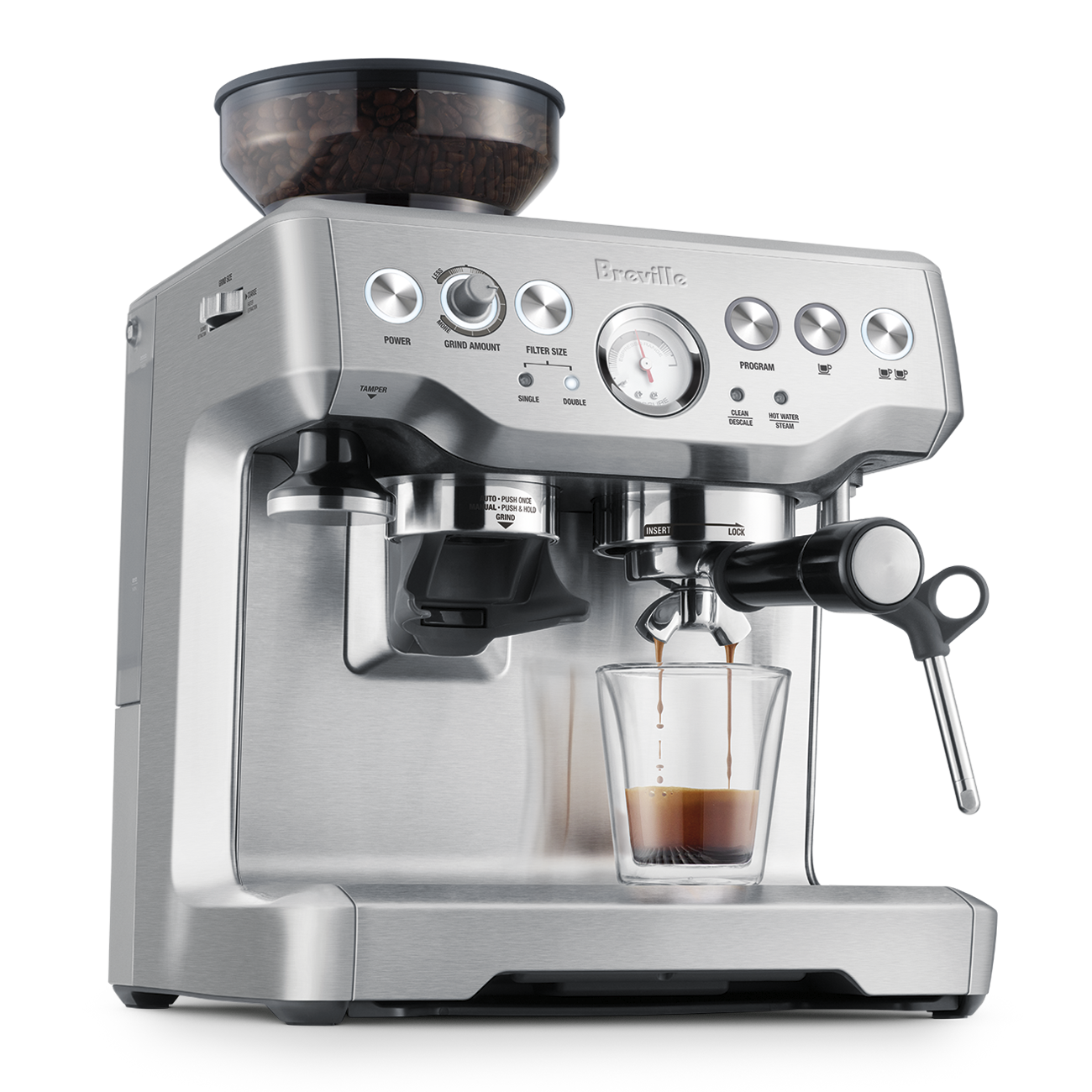
The Barista Express is the learning machine. Breville lists it at $699.95, with an integrated conical burr grinder, 16 grind settings, a pressure gauge, manual milk texturing, and the same core 54mm espresso path. It makes sense if you want one appliance that teaches you espresso fundamentals.
The Barista Touch Impress is the guided premium option. Breville lists it at $1,499.95, with an Impress Puck System, assisted 22lb tamping, automatic dose correction, Auto MilQ milk settings, a touchscreen workflow, 30 grind settings, and cold extraction support. It makes sense if you want help with the steps beginners usually get wrong.
| Model | Official US list price checked May 25, 2026 | Strong fit | Main trade-off |
|---|---|---|---|
| Breville Bambino Plus BES500 | $499.95 | Compact kitchens, separate-grinder buyers, milk-drink beginners | No built-in grinder |
| Breville Barista Express BES870 | $699.95 | Hands-on learners who want grinder and machine together | More technique and cleanup required |
| Breville Barista Touch Impress BES881 | $1,499.95 | Buyers who want guided dosing, tamping, presets, and automatic milk help | High price and larger footprint |
What Breville gets right
Breville's best home espresso machines succeed because they make real espresso variables visible without forcing every buyer into a hobbyist setup. You still grind, dose, tamp, extract, steam, clean, and descale. The difference is that the machines give you more structure than a bare manual setup.
On the Barista Express official page, Breville lists an integrated conical burr grinder with 16 grind settings, a 54mm stainless steel portafilter designed around an 18g dose, low-pressure pre-infusion followed by 9 bar extraction, and a Thermocoil heating system with PID temperature control at 200°F. Those claims matter because espresso quality depends on grind size, dose, puck prep, temperature, pressure, and repeatability.
The Bambino Plus official page keeps the espresso path but removes the grinder. It focuses on compact size, ThermoJet speed, 54mm baskets, automatic milk texture settings, and manual steaming. That makes it a better fit for buyers who want the machine small and the grinder choice separate.
The Barista Touch Impress official page goes the other way. It adds guided operation: assisted tamping, auto dose correction, touchscreen drinks, Auto MilQ settings, and more grinder settings. The promise is not more manual control. The promise is fewer failed steps before the drink is acceptable.
The limit is responsibility. Breville reduces friction, but espresso still punishes stale beans, wrong grind size, dirty baskets, hard water, and rushed cleaning. If you want a no-learning coffee appliance, a super-automatic or capsule machine may fit better. If you want a repeatable ritual with some control, Breville is a credible middle lane.
Bambino Plus: compact machine, separate grinder decision
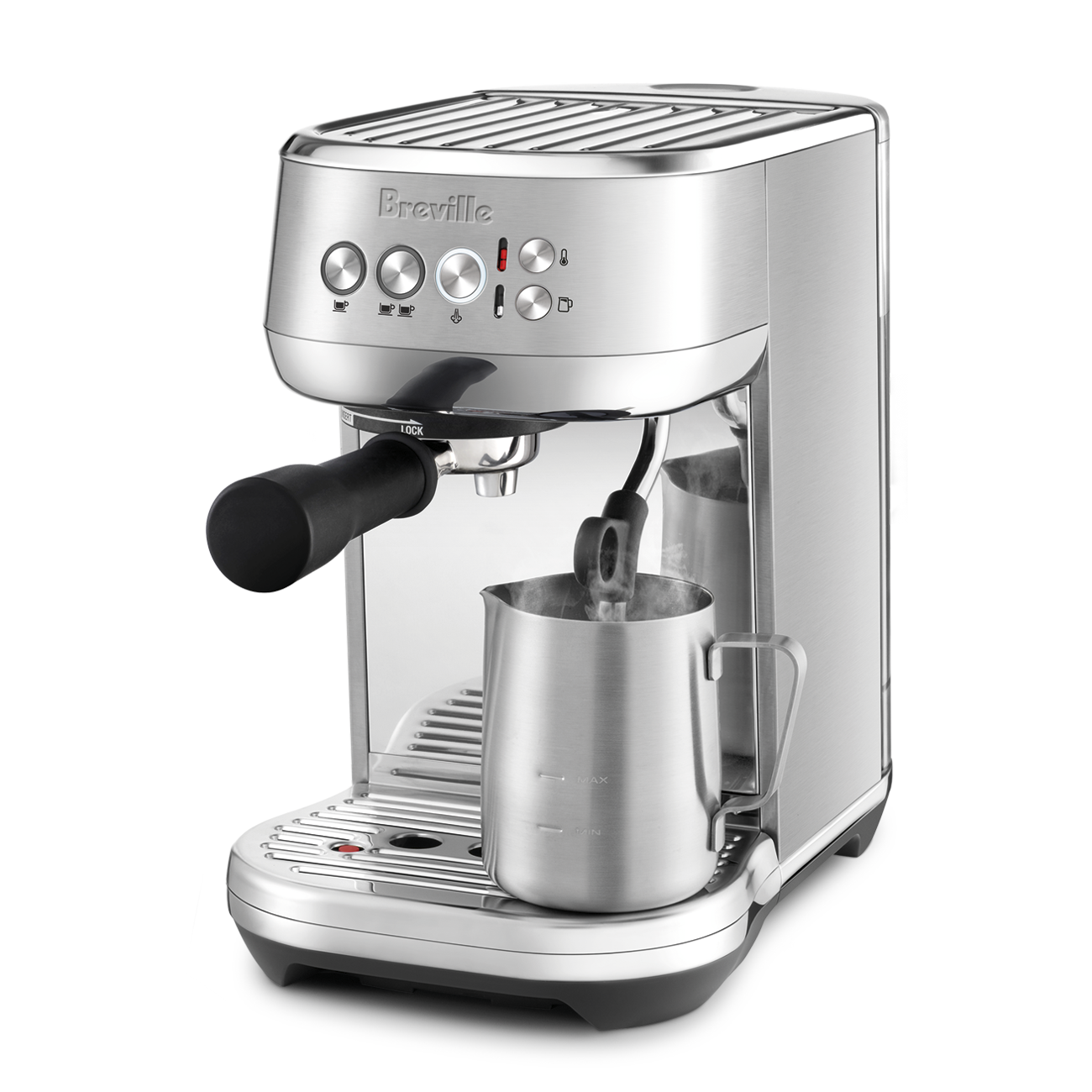
The Bambino Plus is the easiest Breville to fit into a small kitchen. Breville lists its dimensions as 7.5 x 13.5 x 12 inches, which gives it a much smaller counter footprint than the Barista Express or Touch Impress. The official page says it uses a 54mm portafilter with an 18g dose, ThermoJet heat-up in 3 seconds, low-pressure pre-infusion followed by 9 bar extraction, and automatic or manual milk texturing.
That makes the Bambino Plus the cleanest choice if you care about counter space and already understand the grinder issue. It does not include a grinder. That is not a flaw if you want to pair it with a capable burr grinder. It is a problem if you assume the machine alone will deliver the full espresso experience from pre-ground supermarket coffee.
Tom's Guide's 2025 Bambino Plus review is useful because it separates the machine's convenience from its cost. The review praises easy out-of-box use, compact design, and automatic milk steaming that works, while noting that $499 is still expensive for an entry-level machine. That is the right tension. Bambino Plus is small and approachable, but it is not the cheapest way to drink strong coffee.
Buy Bambino Plus if your kitchen is tight, you want a short heat-up time, and you are willing to budget for a grinder. Avoid it if you want one appliance that handles beans-to-shot, or if you do not want to learn how grind quality changes extraction.
Barista Express: the hands-on learning machine
The Barista Express is the classic Breville middle ground. It gives you a grinder, portafilter cradle, pressure gauge, steam wand, hot-water outlet, and a more traditional espresso workflow in one body. Breville's official page lists 16 grind settings, a 54mm stainless steel portafilter, 18g dose support, low-pressure pre-infusion, 9 bar extraction through a 15 bar Italian pump, and PID-controlled Thermocoil heating.
This is the model for buyers who want to learn by changing variables. You grind into the portafilter, tamp, lock in, pull a shot, watch the gauge, taste the result, and adjust. That feedback loop is the reason to buy it. The same loop is also why some buyers abandon it.
Tom's Guide found that the Barista Express produced strong espresso and milk foam, but also said it takes more know-how than simpler machines. CoffeeGeek adds useful history: the BES870XL has been the long-running North American model, and Breville reset the overpressure valve to 9 bar in 2019. That helps explain why some old forum advice about pressure may not apply cleanly to current units.
The built-in grinder is convenient, but it is also the main long-term compromise. If you later become serious about espresso, you may want a dedicated grinder with finer adjustment. At that point, the Barista Express can feel like a strong first serious machine rather than a forever setup.
Buy Barista Express if you want one appliance that teaches espresso fundamentals. Avoid it if you already own a strong espresso grinder, need the smallest footprint, or want the machine to guide dose and tamping automatically.
Barista Touch Impress: guided automation at a premium price
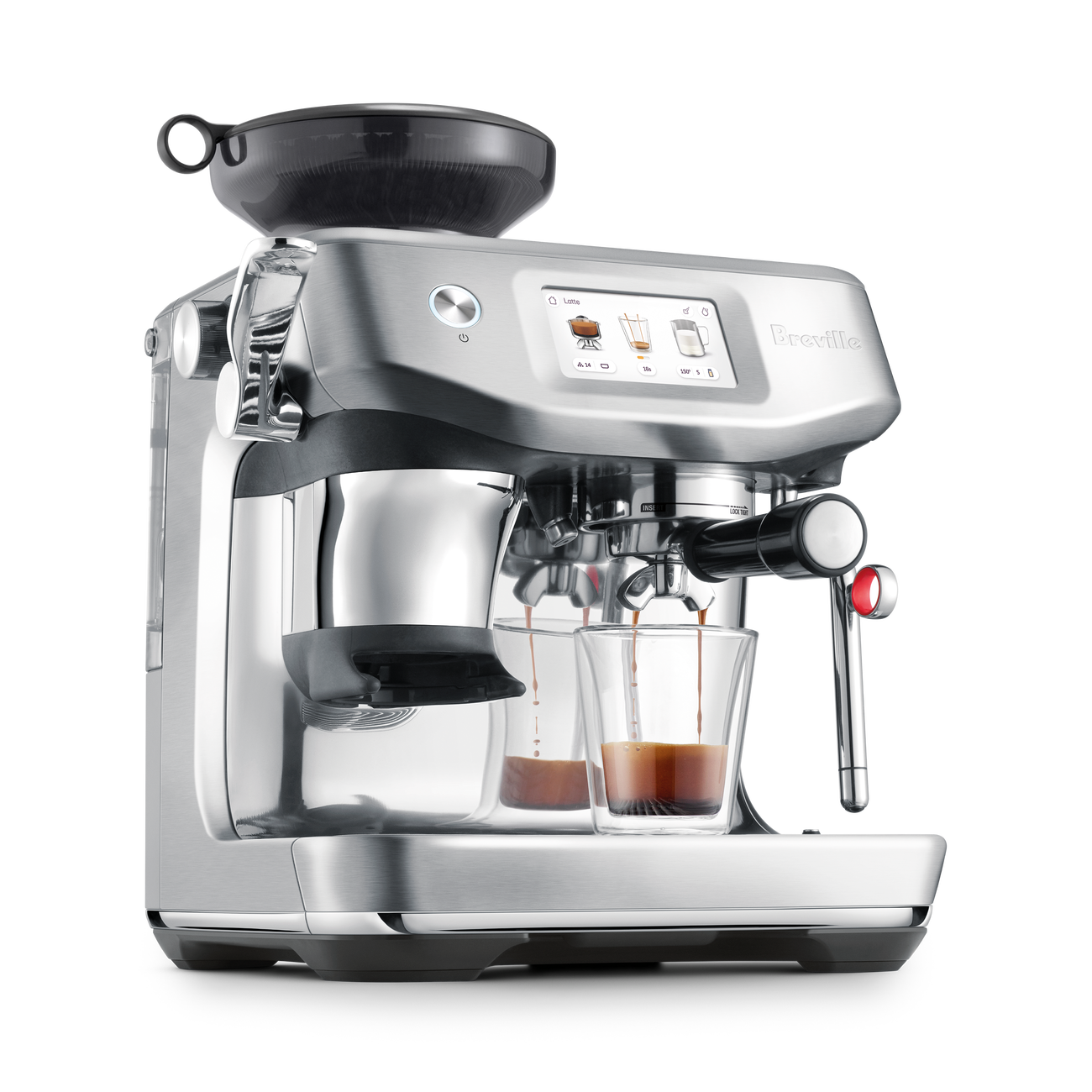
The Barista Touch Impress is the machine for buyers who want fresh-ground espresso but do not want to diagnose every failure alone. Breville's official page lists an Impress Puck System with intelligent dosing, assisted 22lb tamping, auto correction of the next dose, a 7-degree barista twist finish, Auto MilQ settings for dairy, almond, oat, and soy milk, ThermoJet heat-up, and Baratza European Precision Burrs with 30 grind settings.
Those features solve real beginner problems. Dose inconsistency, poor tamping, and milk texture are common reasons home espresso tastes worse than expected. A guided workflow does not guarantee great espresso, but it reduces the number of steps a beginner has to judge cold.
The trade-off is price and footprint. Breville lists the machine at $1,499.95 and 14.2 x 13.4 x 16.3 inches. That is a serious countertop commitment. If you only make one espresso every few days, the convenience may not justify the cost. If you make milk drinks daily and several people in the house will use the machine, the guided workflow has a stronger case.
Independent reviews support both sides. TechRadar's Barista Touch Impress review describes the automated dosing, assisted tamping, AutoMilQ, and touchscreen as major usability advantages. A later TechRadar review of the Sage Barista Touch Impress with Cold Extraction gives an important caveat: the AutoMilq system performed better with oat milk than fresh whole dairy milk in that reviewer's testing. That does not make the machine weak, but it does mean automatic milk should not be treated as flawless.
Buy Barista Touch Impress if you want a premium guided Breville workflow and you make enough drinks to justify the price. Avoid it if you enjoy manual espresso control, already own a grinder, or would rather spend the same budget on a separate machine-and-grinder setup.
How to choose by workflow, not spec sheet
The simplest decision path is workflow first.
Choose Bambino Plus if your first constraint is space. It is the model for apartment kitchens, small counters, and buyers who want to keep the espresso machine compact. It also makes sense if you want to upgrade the grinder separately later. Just do not treat the grinder as optional if espresso quality matters.
Choose Barista Express if your first constraint is learning. It gives enough feedback to teach grind, dose, tamp, pressure, shot time, and milk texture. It is not as guided as the Touch Impress, but that is part of the appeal for buyers who want control.
Choose Barista Touch Impress if your first constraint is consistency across users. In a household where one person wants espresso, another wants a latte, and nobody wants to talk about dose correction at 7 a.m., the guided screen and assisted tamping matter.
Also think about cleaning. All three machines need routine care. The more integrated the workflow, the more places coffee and milk residue can collect. If you buy Barista Express or Touch Impress because they include grinders, expect to clean the grinder path, drip tray, steam wand, portafilter, baskets, and water system. If that sounds unrealistic, a simpler coffee setup may be the better everyday purchase.
Breville versus separate setups and super-automatic machines
Breville's semi-automatic machines sit between two other paths.
A separate setup gives you more upgrade flexibility. For example, a compact espresso machine plus a dedicated grinder can outperform an integrated grinder over time because you can upgrade the grinder without replacing the machine. This is why Bambino Plus can be more appealing to buyers who already know espresso will become a hobby.
A super-automatic machine moves in the opposite direction. It grinds, doses, brews, and often froths with less user input. That is convenient, but you trade away control and usually accept a lower ceiling for texture and extraction quality.
Breville's middle lane is useful because many buyers do not want either extreme. They want better espresso than a capsule system, more ritual than a super-automatic, and less bench complexity than a separate prosumer setup. The key is choosing the model that matches your tolerance for effort.
If you are cross-shopping Breville against De'Longhi, our Breville Barista Express vs De'Longhi La Specialista Arte comparison goes deeper on grinder control, milk steaming, and learning curve. If you are deciding whether Breville is the right countertop brand beyond espresso, see our broader Breville appliances guide.
Buyer risks to check before ordering
First, confirm the exact model and region. Breville and Sage branding differs by market, and similar-looking machines can have region-specific accessories, voltage, warranty terms, or feature differences. This review uses US Breville product pages checked on May 25, 2026.
Second, confirm the grinder plan. Bambino Plus needs a grinder. Barista Express and Touch Impress include grinders, but integrated grinders are not always the final stop for serious espresso buyers. If you expect to upgrade the grinder within a year, Bambino Plus plus a dedicated grinder may be more rational.
Third, measure your counter. The Touch Impress is much larger than the Bambino Plus, and the Barista Express needs working room for the bean hopper, water tank, portafilter, steam wand, and cleaning access. Our kitchen organizers guide is not about espresso, but the same principle applies: the appliance you use daily needs a permanent, reachable place.
Fourth, be honest about milk. Manual steaming rewards practice. Automatic milk can be convenient, but it still depends on milk type, jug position, temperature, wand cleaning, and expectations. If milk drinks are the reason you are buying, read model-specific milk reviews before checkout.
Fifth, plan for maintenance. Hard water, old beans, dirty baskets, and ignored descaling prompts can make a good machine taste bad. The best Breville choice is still the wrong buy if you will not keep it clean.
Related home and kitchen guides
If you are choosing a whole countertop setup, start with our Breville appliances guide for a broader view of the brand. If the decision is specifically between two semi-automatic espresso systems, read Breville Barista Express vs De'Longhi La Specialista Arte. For kitchen layout and storage planning, our best kitchen organizers guide and lighting fixtures guide help with the space around the machine rather than the machine itself.
FAQ
Are Breville espresso machines worth it?
They are worth considering if you want real espresso at home and are willing to clean, descale, dial in beans, and learn a repeatable workflow. The value is weaker if you want a fully automatic push-button machine with almost no puck preparation or milk effort.
Which Breville espresso machine is easiest for beginners?
The Barista Touch Impress is easiest because it guides dose, tamping, drink selection, and milk texture. Bambino Plus is physically simpler, but it still needs a capable grinder and some puck-prep discipline.
Do I need a grinder with the Bambino Plus?
Yes, unless you plan to use pre-ground coffee with pressurized baskets. For better espresso, pair Bambino Plus with a burr grinder that can make fine espresso adjustments. The grinder matters as much as the machine.
Is the Barista Express better than the Bambino Plus?
It is better if you want an integrated grinder and a hands-on learning workflow. Bambino Plus is better if you want a smaller machine and prefer choosing or upgrading the grinder separately. Neither is universally better.
Is the Barista Touch Impress worth the upgrade?
It is worth comparing if guided dosing, assisted tamping, touchscreen drinks, and automatic milk settings matter more than price. It is less compelling if you enjoy manual control or already own a grinder.
How current are the prices in this review?
Official US list prices were checked on May 25, 2026. Breville promotions and retailer prices change often, so confirm checkout pricing before buying. Treat the prices here as research snapshots, not guaranteed offers.
Sources reviewed
- Breville Barista Express BES870 official page
- Breville Bambino Plus BES500 official page
- Breville Barista Touch Impress BES881 official page
- Tom's Guide Barista Express review
- Tom's Guide Bambino Plus review
- TechRadar Barista Touch Impress review
- TechRadar Sage Barista Touch Impress with Cold Extraction review
- CoffeeGeek Barista Express first look
Final recommendation: start with the routine. Choose Bambino Plus if you want compact flexibility and a separate grinder path. Choose Barista Express if you want to learn espresso with one machine. Choose Barista Touch Impress if guided dosing, tamping, and milk support solve a real daily problem. The wrong Breville is the one whose workflow you will not repeat after the first week.