Affiliate disclosure: This guide may earn a commission if you choose to visit a retailer through our referral link, at no extra cost to you.
Vevor’s France-facing storefront presents a broad catalogue of practical goods, while its individual pages provide useful details for comparing a specific item. This is a referral guide based on the retailer’s public information, not an independent product test. The most useful approach is to identify the exact product, check its current specifications and terms, then compare it with alternatives that fit the same job.
What Is Vevor?
Vevor is a retailer whose France-facing storefront displays a wide set of shopping categories for practical home, garden, workshop and equipment needs. The official navigation includes areas such as lawn and garden, tools, automotive, outdoor improvement, plumbing, appliances, construction materials, heating and cooling, electrical equipment, sport and outdoor goods, storage, kitchenware, flooring, furniture, cleaning, lighting, bathroom fittings, safety equipment and industrial or scientific supplies.
That breadth is the clearest starting point for evaluating the retailer. It suggests that a shopper can begin a search for many project-led purchases in one catalogue, rather than treating Vevor as a specialist in only one type of product. It does not establish that every category will contain a suitable item for every project, or that a product is available at any particular time. Category pages and stock can change, so the exact listing remains the important reference before purchase.
This guide therefore focuses on what the official storefront and a sample listing make visible: catalogue coverage, product-page information and a cautious way to compare options. It does not claim independent testing, long-term durability, delivery performance, returns handling or after-sales outcomes. For readers comparing practical alternatives, Vevor may be worth investigating when its listed specifications appear to match the project, but the decision should rest on the current item-level information rather than the brand name alone.
Shop Vevor Review: Product Range, Practical Fit and Alternatives →
The Vevor Product Range
AI-generated generic editorial illustration — not a retailer product photo and does not depict the reviewed product or service. Provide a neutral visual comparison that supports the reader's decision without depicting a real product.
 The official Vevor France storefront shows categories spanning ordinary household projects and more specialised equipment searches. A reader looking for tools can also see plumbing, cleaning, lawn and garden, electrical equipment, automotive, construction-material and kitchen-related areas in the same catalogue. Other displayed categories extend into storage, furniture, lighting, flooring, safety equipment, industrial and scientific supplies, sport and outdoor goods, and children’s play sets.
This range can be useful when the shopping task is practical rather than brand-led. For example, someone planning outdoor work may start with garden tools, irrigation or powered outdoor equipment; a home-improvement search may lead to plumbing, construction materials, doors, windows, lighting or bathroom fittings. A workshop or vehicle-related task may call for tools, automotive products, electrical equipment or safety items. The storefront also lists cleaning as a distinct area, which is a useful reminder that the catalogue reaches beyond conventional hand tools and garden accessories.
A broad category menu is a discovery tool, not a product recommendation. Similar category labels can cover products with very different capacities, dimensions, materials, power requirements and included accessories. A reader should use the category to narrow the search, then open the relevant listings and compare the details that affect the intended job. If compatibility matters—for example with an existing installation, vehicle, electrical setup or available space—the listing should be checked against the user’s own requirements before it is treated as a viable option.
The catalogue also should not be read as a promise of universal availability. The storefront establishes that these areas are displayed, but individual product selection, variants and current terms may differ by listing. That distinction helps keep the comparison grounded: use Vevor’s category breadth to find possibilities, and use the exact page to decide whether one of them deserves further consideration.
How To Read A Vevor Product Listing
An individual Vevor listing can give a reader a more concrete basis for comparison than a category page. The supplied official example is for a children’s supermarket play set. Its title identifies it as a VEVOR children’s supermarket or grocery-shop play set and lists dimensions of 81.5 x 30.7 x 85 cm. The title also describes an MDF construction and names accessories including a shopping bag, conveyor belt, scanner and cash register. It is presented for boys and girls aged three years and over.
Those displayed details show the kinds of questions a shopper can begin to answer from a listing. Start with the product name and intended use: is the item actually for the job in mind, rather than merely in a related category? Then compare the listed dimensions with the available space, storage constraints or installation area. For the play-set example, size is especially relevant because a reader may need to assess where it can be used and stored. For other product types, equivalent details might include capacity, fittings, voltage, mounting requirements, weight or accessory compatibility.
Material descriptions and included items deserve the same close reading. The example listing names MDF and several play accessories, but a reader should still check the current page for the full specification, variant selection and any details that matter for the intended user. The page also displays a customer-review score and comment count. That display can be a useful signal to investigate, but it is not independent testing and should not replace a use-case-specific comparison of the actual specifications.
Finally, check for practical details that may change: the selected variant, quantities, package contents, dimensions, current price display and any current delivery or return information presented with the listing. A well-matched product is not simply one with a familiar title or a promising category label; it is one whose currently displayed details align with the task and the buyer’s constraints.
Where Vevor May Be A Practical Fit
Vevor may be a practical place to start when a reader is searching for a defined project need and is prepared to compare specifications carefully. The official storefront’s category structure covers tools, plumbing, cleaning, lawn and garden, electrical equipment and several adjacent areas. Its dedicated cleaning-equipment category is particularly useful evidence that the catalogue includes specialised equipment areas as well as general home and outdoor categories.
That can suit readers who prefer to begin with the job they need to complete. A cleaning-equipment search, for instance, should start by defining the surface, scale of the task, available space, power source and any compatibility requirements. The category can help locate relevant products, but it cannot establish that every listing will suit those requirements. The same principle applies to plumbing components, garden equipment, tools or electrical items: compare the exact technical and practical details before deciding that a category match is a project match.
Vevor may also be useful for readers who want to explore several related product areas without moving immediately between separate retailer catalogues. That is a convenience of browsing scope, not a claim about price, quality or service. Once a candidate item has been found, a shopper should compare it with alternatives that serve the same purpose. The comparison is strongest when it starts from a written list of non-negotiables: dimensions, materials, included items, compatibility and the current total cost under the terms available to that buyer.
The retailer is less straightforward to assess when the project depends on a precise fit, a regulated installation, unusual technical requirements or a service outcome that the available official pages do not document. In those situations, category presence is only the first step. Check the current listing, consult any relevant professional guidance where appropriate, and avoid assuming that a broadly named category answers the technical questions.
What To Check Before Buying
AI-generated generic editorial illustration — not a retailer product photo and does not depict the reviewed product or service. Reinforce pre-purchase checks without making unsupported quality or service claims.
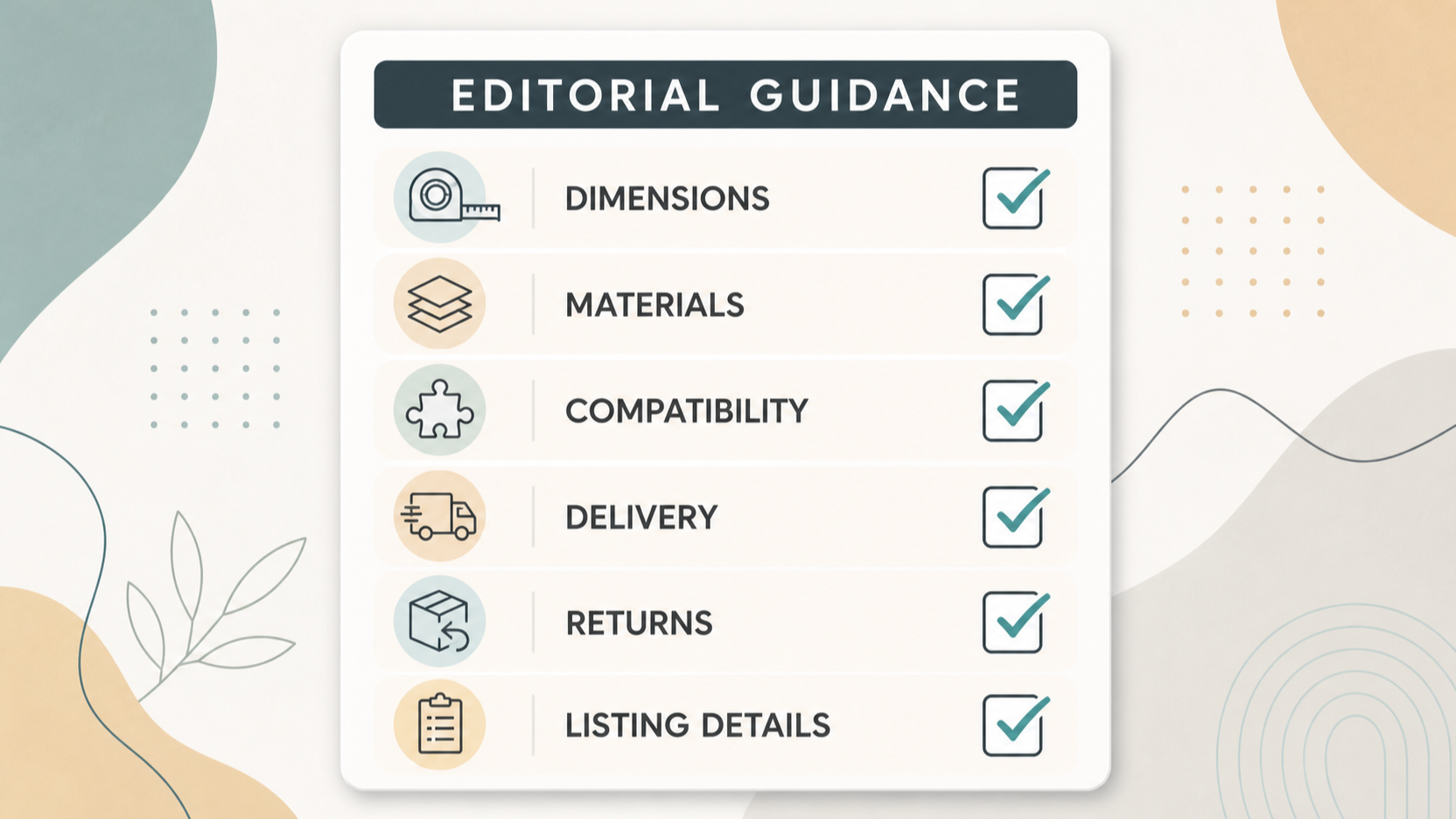 The available official evidence demonstrates that Vevor displays a substantial category range, a cleaning-equipment category and product-page details for a specific children’s play set. It does not independently establish product durability, real-world performance, current delivery outcomes, return handling or after-sales support. Those are material purchase questions, so they should be checked directly on the current listing and applicable retailer terms before an order is placed.
Begin with suitability. Confirm that the exact product—not merely its category—matches the intended task. Check dimensions against the available space; check materials against the expected use; and identify all listed included items. Where a product must connect to an existing system, verify sizes, fittings, voltage, mounting method or other compatibility points. If the page offers variants, make sure the selected option is the one whose specifications you are comparing.
Next, check the current commercial terms. Review the current price display, delivery information, return conditions and any charges that affect the delivered total. These may vary by product, variant, location or time, so an older screenshot, category label or third-party summary is not a substitute for the live listing and terms. If the purchase is time-sensitive, recheck the information immediately before ordering.
Customer-review displays can help a reader decide whether to investigate further, but they do not prove that the item will perform well in a different setting. Read the product description and specifications first, then use reviews as supplementary context rather than as a replacement for fit checks. For a higher-stakes, expensive or technically demanding project, compare at least one alternative with the same required specifications and keep a record of the current terms being compared.
The core discipline is simple: match the item to the job, verify the current listing, and separate documented facts from assumptions. That keeps the decision useful even when the available evidence is limited to retailer information.
Shop Vevor Review: Product Range, Practical Fit and Alternatives →
How To Compare Vevor With Alternatives
AI-generated generic editorial illustration — not a retailer product photo and does not depict the reviewed product or service. Provide a neutral framework for comparing a specific VEVOR listing with alternatives.
 Compare a specific Vevor listing with alternatives that solve the same problem, rather than comparing retailers in the abstract. Start by defining the non-negotiable requirements for the project. These might include dimensions, materials, capacity, power or fitting compatibility, included accessories, installation needs and the intended environment. Put each candidate against that same list so that a lower price or a broader category label does not obscure a missing requirement.
Then compare the item-level information. The official play-set listing illustrates why title details, dimensions, materials, age guidance and included items can all matter at once. In a different category, use the equivalent specifications: for example, a required connection type, electrical characteristics, load capacity or physical footprint. Check that each comparison uses the chosen variant and current listing information, not a generic product family description.
Commercial terms should be compared separately from product specifications. Review the current displayed price, delivery terms, return conditions and the total delivered cost that applies to the reader’s circumstances. Do not assume that one retailer is cheaper, faster or easier to return to without current evidence for the exact items being considered. If two products differ in package contents, account for the cost of any additional parts needed to make them comparable.
A short comparison table or notes list can prevent a rushed decision: requirement, Vevor listing detail, alternative listing detail, and unresolved question. Any unresolved compatibility or terms question is a reason to pause rather than infer an answer. This approach is neutral and repeatable: it helps identify a good specification match without claiming that Vevor or any alternative will always offer better value, quality or service.
Vevor FAQ
What kinds of products does Vevor list?
The official France storefront displays categories including lawn and garden, tools, automotive, plumbing, appliances, construction materials, electrical equipment, storage, kitchenware, cleaning, lighting, safety equipment and industrial or scientific supplies. Treat this as catalogue breadth rather than a guarantee that a particular item is currently available.
What details should I compare on a Vevor product page?
Check the exact product name, selected variant, dimensions, materials, included items and any compatibility details relevant to the task. The supplied children’s play-set page, for example, displays dimensions, MDF in the title, age guidance and named accessories. Recheck the live listing before purchase because product details and terms can change.
Should I compare alternatives before buying from Vevor?
Yes. Compare the exact listing with alternatives that meet the same requirements, including specification match, dimensions, materials, package contents, current delivery and return terms, and total delivered cost. Category presence and listing information are useful starting points, not substitutes for a use-case-specific decision.
Sources
Editorial information: About our editorial team · Read our editorial policy · Read our affiliate disclosure.
Shop Vevor Review: Product Range, Practical Fit and Alternatives →