Affiliate disclosure: This article may contain affiliate links. If you follow a link and make a purchase, the publisher may earn a commission at no extra cost to you.
Hunter Fan referral guide
Hunter Fan is best approached as a broad shopping option for ceiling fans and lighting, not as a one-size-fits-all answer. Its public catalogue presents several routes into the range—by room, feature, style, colour or material, and lighting type—while its outlet and promotions pages add price-sensitive options that can change over time. The useful question is therefore not simply whether the brand is “good value”, but whether the available fan type, controls, dimensions, live price and purchase terms suit your room and buying priorities.
Hunter Fan at a glance
AI-generated generic editorial illustration — not a retailer product photo and does not depict the reviewed product or service. Provide a neutral visual comparison that supports the reader's decision without depicting a real product.
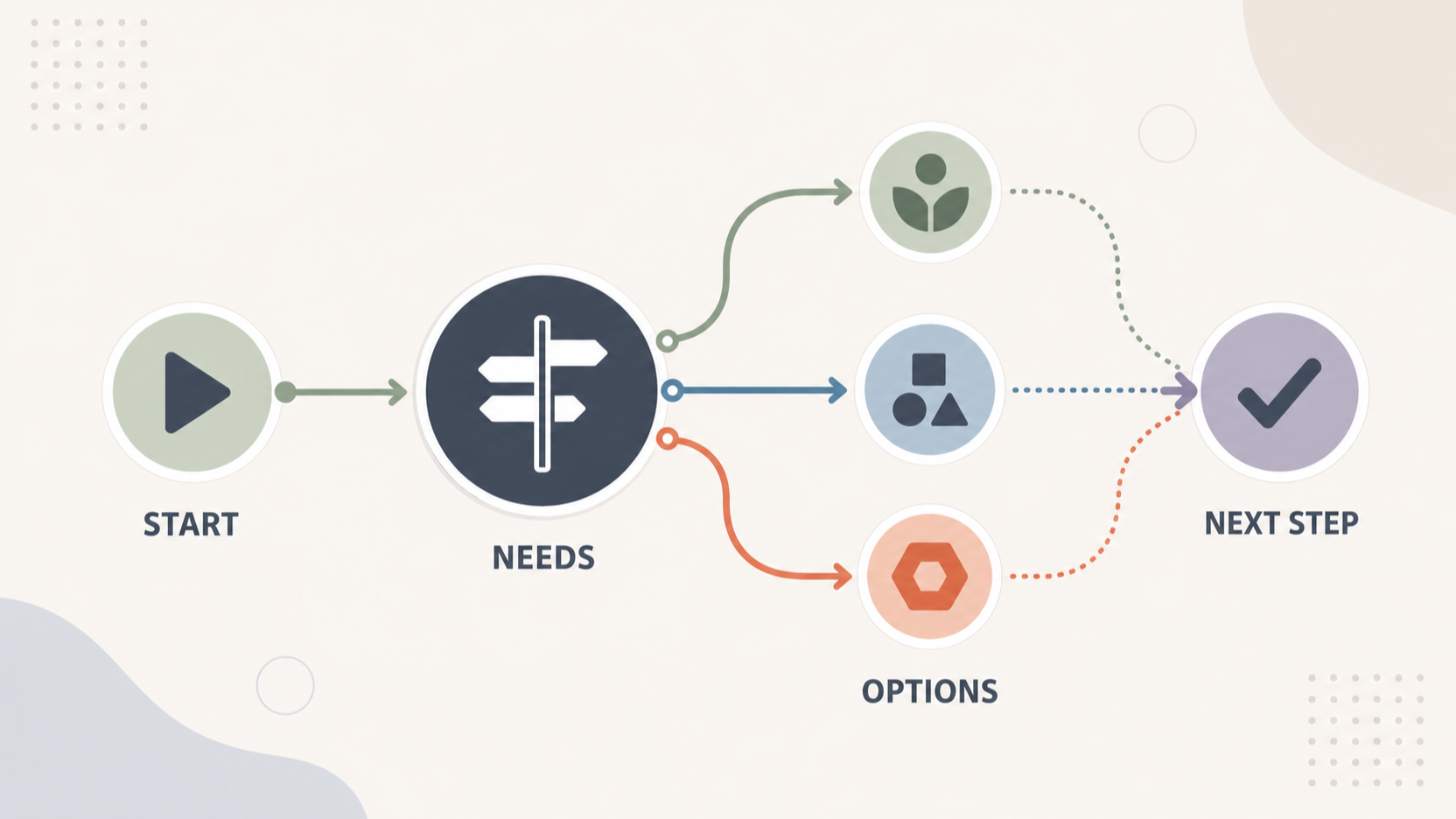 Hunter Fan’s website positions the brand around ceiling fans and lighting. On the main shopping pages, readers can move between fan categories and lighting categories rather than treating the catalogue as a single product line. That matters if you are planning a room as a whole: a fan with integrated lighting may suit one brief, while a separate ceiling light and fan may be the better route for another.
The starting point is practical rather than promotional. Hunter’s own navigation gives shoppers several ways to narrow a ceiling-fan search, including room, style, feature, colour or material, outdoor use and lighting-related choices. Its homepage also points to a buying guide and a fan-selection quiz, which can be useful prompts when you have not yet settled on the room, mounting arrangement or preferred controls. These are merchant tools, so they should inform your shortlist rather than replace checking the individual product page.
The public site also displays a Hunter Outlet, current offers, a free-shipping threshold, hassle-free returns language and a limited lifetime warranty statement. Those signals give a shopper areas to investigate, but they are not a promise that every item, location or order will qualify in the same way. Product availability, pricing, promotional eligibility and checkout totals can all be different from the broad message shown on a landing page.
For a comparison with other retailers, begin with the product you actually need. Establish the room’s intended use, whether a light is required, whether a low-profile or outdoor design is relevant, and how you want to control the fan. Then compare the resulting shortlist on current price, delivery conditions, warranty information and returns details. That is a sounder basis than relying on generic claims about brand value or performance.
Range and shopping options
The range is structured to support several common buying paths. A reader who starts with the room can browse options for spaces such as patios, bedrooms, living rooms, kids’ rooms and kitchens. A reader who starts with appearance can use style groupings such as modern, fandeliers, rustic farmhouse, nautical and coastal. There are also colour and material filters including white, black, brushed nickel, chrome and bronze. These labels do not settle whether a particular model will fit; they simply make it easier to turn a broad preference into a smaller set of product pages.
Feature-led shopping is likely to be more useful when the installation or control requirement is already clear. Hunter lists categories for fans with lights, low-profile fans, outdoor fans, fans with remote control and smart fans. An integrated light can reduce the need for a separate ceiling fixture, while a remote-control category may appeal where wall-control access is inconvenient. Smart-fan options are worth considering only if the listed compatibility, setup requirements and chosen home ecosystem work for you. The sale page says selected HunterSMART models work with Alexa, HomeKit and Google Home; compatibility should still be confirmed against the exact model before purchase.
Outdoor use needs an extra check. The catalogue includes outdoor shopping paths and highlights WeatherMax among its technology labels, but an outdoor location can differ in exposure to moisture, wind, heat and salt air. Use the individual listing and installation documentation to establish the product’s stated suitability for the intended position; do not assume every outdoor-looking model has the same specification.
The same discipline applies to low-profile, with-lights and remote-control filters. “Low profile” does not by itself confirm clearance above a tall person’s head, and “with lights” does not answer whether the fixture provides the brightness or light quality you want. Compare the product-level dimensions, mounting requirements, included controls and light details with your room before adding a model to a final shortlist.
Lighting sits alongside fans in the broader catalogue, with types such as chandeliers, pendants, flush mounts, wall sconces and bathroom vanity lights listed on the promotions page navigation. That breadth may be convenient if you are coordinating finishes across a room. It should not be a reason to bundle automatically: compare the individual product prices and terms, then decide whether a combined order genuinely helps your budget or design brief.
Sales, outlet and promotional value
Hunter’s outlet and clearance pages are useful places to begin a budget comparison, because they present an evolving selection of sale fans across sizes, styles and price points. The sale category says that clearance products can include models with or without lights, remote-control features and, on selected models, smart technology. This gives a shopper a way to look for a specific feature at a lower displayed price instead of treating clearance as a separate, feature-poor range.
The important qualifier is that clearance is live merchandising, not a fixed price list. A product shown today can sell through, change price or leave the category. Treat an outlet item as a lead to investigate: open the exact listing, check the displayed regular and sale price, review the stated product details, and make sure the selected finish or size is the one covered by the offer. If a comparison retailer has a similar product, compare the final configuration rather than a headline “from” price.
Hunter’s promotions page states that featured deals and discount coupon codes are updated frequently. At the time reflected in the supplied merchant material, it displayed an offer of 20% off fans and light orders of $329+ using code FRESH4SCHOOL, through 27 July. That is a time-limited, threshold-based mechanism—not a general discount—and should be rechecked on the official promotions page before you rely on it. The same page also shows featured-deal examples with individual sale prices, which reinforces the need to verify each item rather than extrapolate one discount across the catalogue.
A sensible budget workflow is to separate product price from promotional conditions. First, identify models that meet the room and feature requirements. Next, check whether an outlet listing, a code, a selected-collection offer or a spend threshold applies to that precise basket. Finally, check shipping and tax at checkout before deciding which retailer is cheaper. This approach avoids a common mistake: comparing a discounted headline against another seller’s final price without accounting for eligibility, delivery or the actual configuration.
Limits and checks before buying
AI-generated generic editorial illustration — not a retailer product photo and does not depict the reviewed product or service. Summarize the key checks readers should make before purchasing.
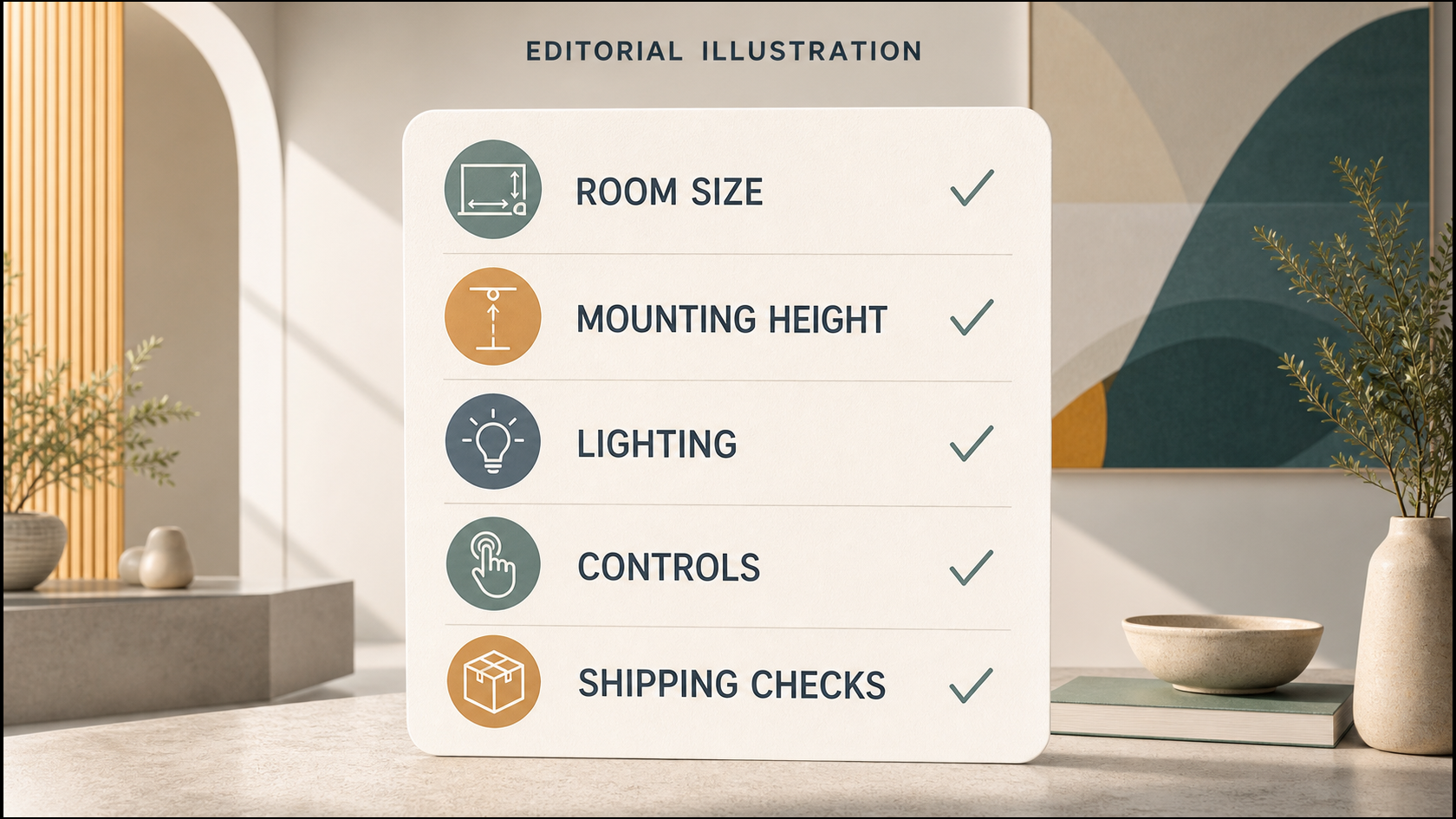 Before ordering, verify the product page first and the checkout page second. The product page is where you should confirm dimensions, mounting style, intended room or outdoor suitability, lighting configuration, included controls, selected finish and current price. The checkout is where you can test whether a promotion applies to your basket and see the delivery and tax treatment that applies to your order. A broad category page is helpful for discovery, but it is not a substitute for these item-level checks.
Hunter’s homepage advertises free shipping on orders of $199+ and describes returns as hassle-free. It also displays a limited lifetime warranty statement. These are useful policy signals, but a careful buyer should read the current terms and any product-specific exclusions before treating them as an assurance for a particular order. In particular, check whether the relevant threshold is measured before tax, whether exclusions apply, what return condition or timeframe is stated, and how the warranty is described for the model under consideration.
Delivery deserves particular attention for readers outside the merchant’s main displayed market or for bulky purchases. The supplied pages show dollar-denominated offers and a $199 shipping threshold, but they do not establish that a given destination, delivery service or final charge will be available. Confirm this directly during the order process or through the merchant’s current help information rather than assuming a policy shown on a general page applies to your address.
Keep promotion checks equally specific. A code can have a spend minimum, end date, collection restriction or other terms. An outlet item may be reduced without qualifying for an extra code. If a product is included in a featured deal, confirm that the correct variant is selected and that the live cart still reflects the advertised amount. Taking screenshots or saving the relevant terms before checkout can make later comparison easier, but the merchant’s live checkout information should be treated as the decision point.
How Hunter Fan compares with alternatives
AI-generated generic editorial illustration — not a retailer product photo and does not depict the reviewed product or service. Frame a neutral feature-led comparison with alternative shopping options.
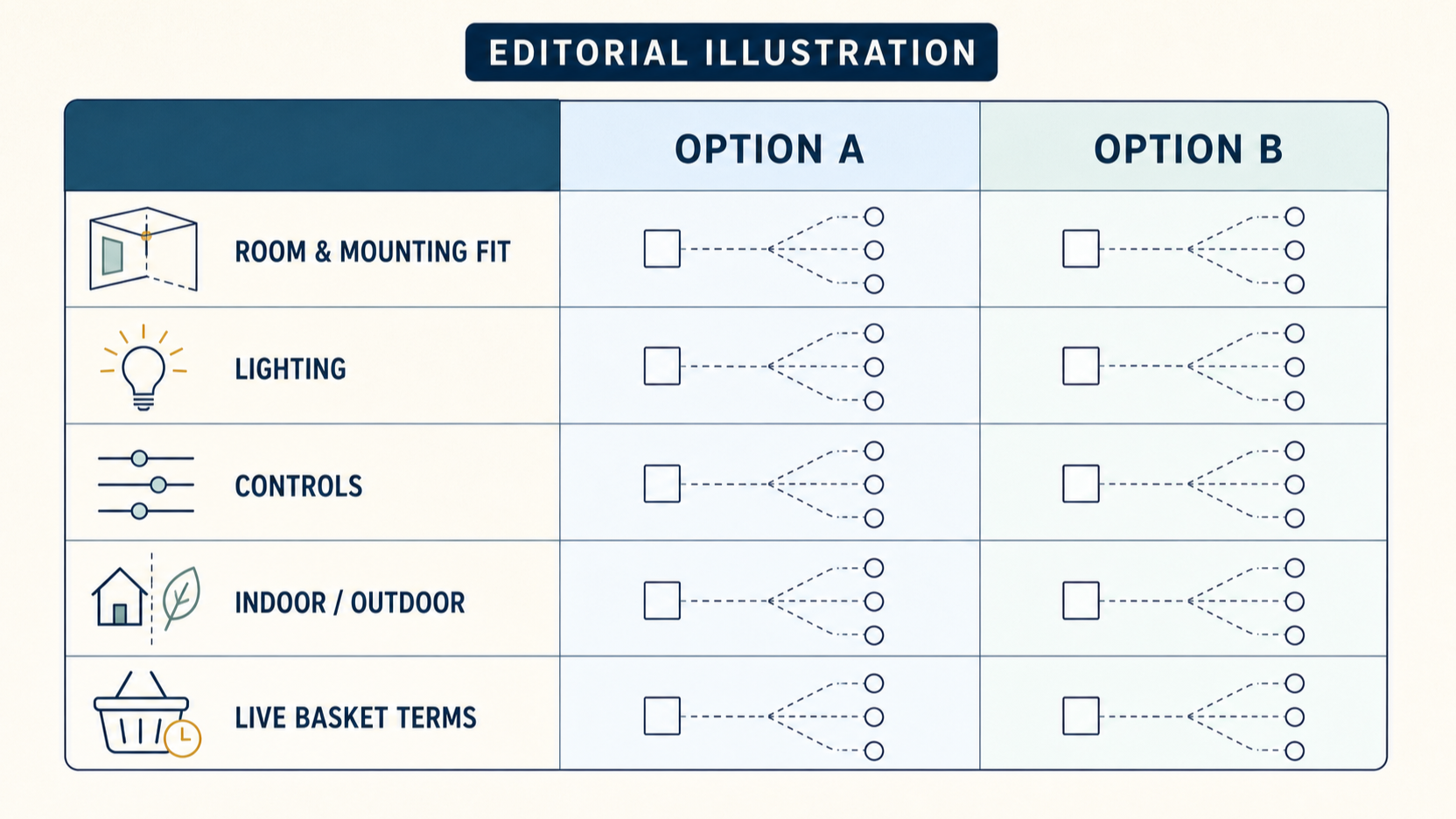 Hunter Fan is worth comparing with alternatives when more than one retailer can meet your core functional requirements. Start with fit, not branding. A low ceiling, a covered patio, a need for integrated lighting or a preference for remote and smart controls can quickly narrow the relevant products. Once you have a short list, compare like with like: similar room suitability, dimensions, control method, lighting arrangement, finish and stated installation requirements.
A feature comparison can be kept neutral with five questions. Does each model suit the room and mounting height? Does it provide the light arrangement you need? Does it offer the control method you prefer? Does its product-level specification support the intended indoor or outdoor setting? And what is the complete current cost once the selected configuration, promotion and delivery terms are considered? Hunter’s public navigation makes these categories visible, including with-lights, low-profile, outdoor, remote-control and smart routes, so the brand can be assessed against the same criteria you use elsewhere.
Budget comparisons should be time-aware. Hunter has an outlet, clearance category and promotions page, and its sale range describes a changing selection. A competing retailer may have a different mechanism: an automatic reduction, bundle offer, delivery incentive or a lower base price. None should be treated as inherently better without checking the exact product and live conditions. Compare the basket total and the stated terms on the same day if price is decisive.
After-sales information is another useful tie-breaker. Review the current returns language, warranty details, replacement-parts availability and support information for each shortlisted option. Hunter’s site links to product registration, replacement parts and owners’ manuals, as well as warranty and recall information. That may be relevant if you value access to documentation, but it is still worth confirming that support materials exist for the specific model rather than assuming that every product has identical coverage.
There is no need to rank retailers generally. The better choice depends on the model that fits your room, the controls you will actually use, the terms available at the time of purchase and the level of after-sales detail you are comfortable with.
Who Hunter Fan may suit
Hunter Fan may be worth investigating if you want to compare ceiling fans and lighting within one catalogue, especially when your shortlist is shaped by room, style, lighting, remote-control, smart-home or outdoor requirements. It may also be useful for price-sensitive shoppers willing to monitor the official outlet, clearance and promotions pages for a suitable configuration. The selection tools and category routes can help turn a broad idea into a manageable shortlist.
It may be less straightforward for a buyer who needs a fixed all-in price before browsing, requires a confirmed delivery arrangement to a specific destination, or cannot spend time checking model-level details and live promotion terms. In those cases, the right response is not necessarily to rule Hunter out; it is to confirm the practical constraints early, before becoming attached to a particular sale price or finish.
Use a simple final checklist. Choose the room and mounting conditions. Decide whether integrated lighting, a remote or smart compatibility is essential. Open the exact product page and confirm the relevant dimensions, controls, price and stated suitability. Then visit the official outlet or promotions page to see whether a current offer applies, and verify the final delivery, tax and return information at checkout. If another retailer remains in contention, repeat the same checks for an equivalent model.
Frequently asked questions
Does Hunter Fan offer ceiling fans with lights and remote-control options? Yes. Hunter’s public feature navigation includes “With Lights” and “With Remote”, while its sale category says that sale fans can include models with or without lights and remote-control features. Check the exact listing for the configuration you want.
Where can shoppers check Hunter Fan clearance items and current promotions? The official Hunter Outlet and the ceiling-fan sale category are starting points for clearance stock. The official promotions page lists current featured deals and coupon-code offers; check it again before purchase because terms and availability can change.
What should shoppers confirm before relying on a Hunter Fan offer or delivery policy? Confirm the exact product, selected variant, current price, offer eligibility and expiry, shipping threshold, destination availability, tax and checkout total. Also review the current returns and warranty terms that apply to the order.
Sources
Editorial information: About our editorial team · Read our editorial policy · Read our affiliate disclosure.